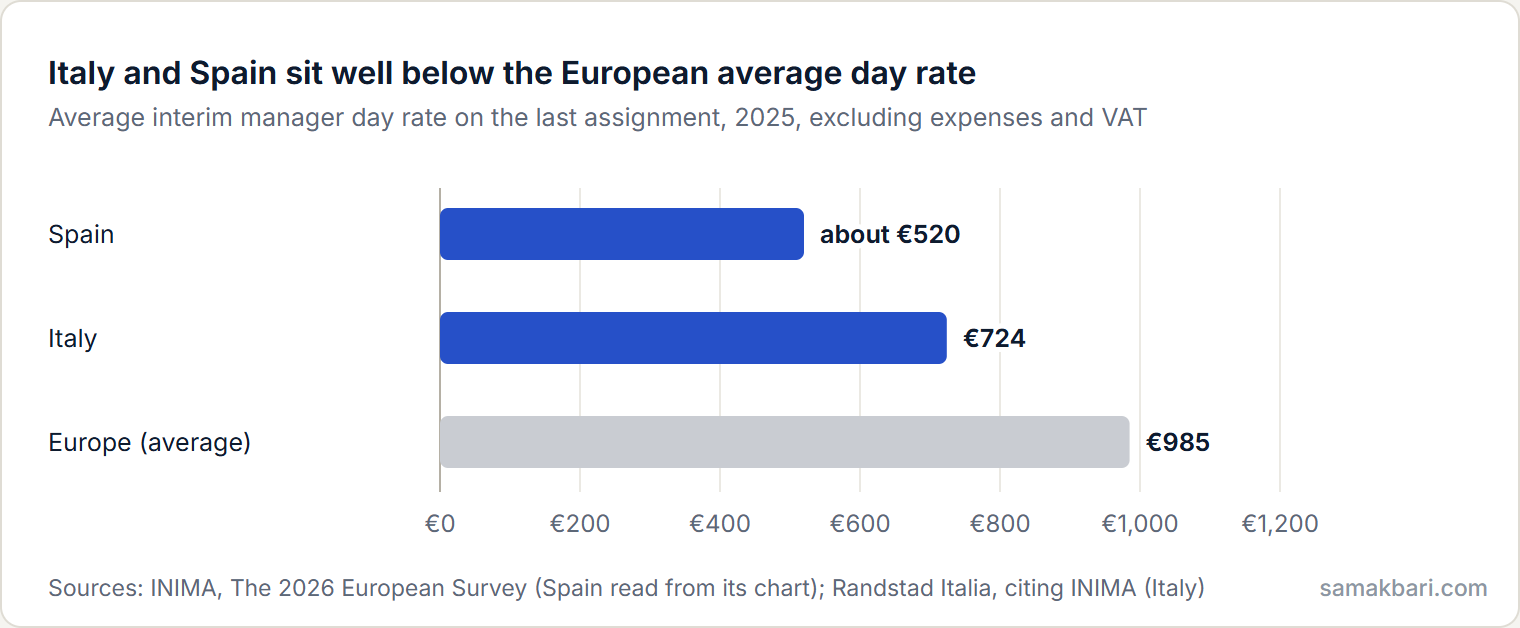

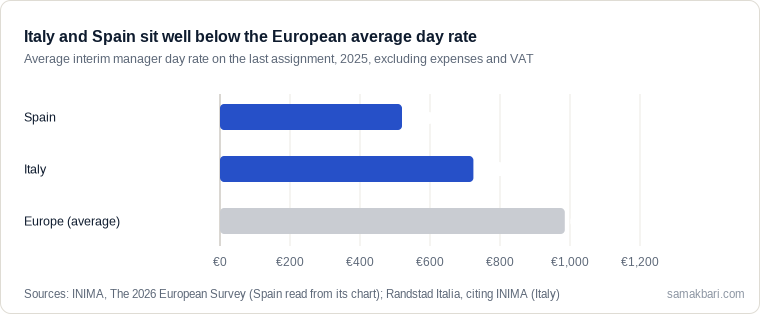
Short answer: Italy calls it a temporary manager and Spain an interim manager, but it’s the same job: a senior executive who takes a leadership role for a defined period, with real authority, and then hands over. The average day rate was €724 in Italy and a little over €500 in Spain in 2025, against a European average of €985 (INIMA 2026 survey; Italian figure as reported by Randstad Italia). Full-time, that’s roughly €10,000–€15,000 a month before expenses and VAT, usually through a services contract with the manager’s own company.
I offer fractional and interim roles in Italy and Spain as well as Australia, and the question usually comes from one of two places: Australian groups with a European subsidiary that needs a leader, or Italian and Spanish boards weighing fractional executives against what they already use. This is the plain version, with the local figures and the legal points that matter.
Temporary manager or interim manager: what’s the difference?
Only the name. Italian business uses the English words “temporary manager” and “temporary management”; Spain uses “interim manager” and “interim management”, as do the UK, Germany and the Netherlands. In both countries the role is the same:
- A defined mandate. Cover a vacancy, run a turnaround, integrate an acquisition, prepare a sale or manage a generational handover in a family business.
- Real authority. The manager runs the function or the company, not a report about it. That’s what separates the role from a consultant.
- A planned exit. The assignment ends with a permanent appointment and a handover, or with the program delivered.
One trap in Spanish: don’t translate it as directivo interino. In Spain interino reads as a temporary public-sector employee, so Spanish companies and search engines use the English “interim manager”.
Across Europe, change management and process improvement were the most common reasons for an assignment, and more than 60% of interim managers had held roles at C-level or above (INIMA 2026). In Southern Europe about half of all assignments were in companies with fewer than 100 employees. This is a mid-market tool as much as a big-company one.
What does a temporary or interim manager cost in Italy and Spain?
| Italy (temporary manager) | Spain (interim manager) | |
|---|---|---|
| Average day rate, 2025 | €724 | a little over €500 (about €520) |
| Published ranges | About €500 a day for specialist roles in smaller companies, up to €1,500–€2,000 for C-level roles in mid-caps | €500–€800 a day for a functional director, €800–€1,300 for an interim CEO or general manager |
| Full-time month (about 20 days) | About €14,500 at the average | About €10,400 at the average; €16,000–€26,000 for an interim CEO |
| Change in day rates in 2025 | About flat | Down about 12%, the steepest fall in Europe |
| VAT | Reverse charge (inversione contabile) when the manager’s company is outside Italy | Reverse charge (inversión del sujeto pasivo) when the manager’s company is outside Spain |
Sources: averages and the 2025 change from the INIMA 2026 European survey (net day rate on the last assignment, excluding expenses and VAT; the Spanish figure and the changes are read from the survey’s charts); the Italian average and range as reported by Randstad Italia (the Italy bar in the INIMA chart reads about €710); Spanish ranges from Manager in Motion. Read 20 November 2026.
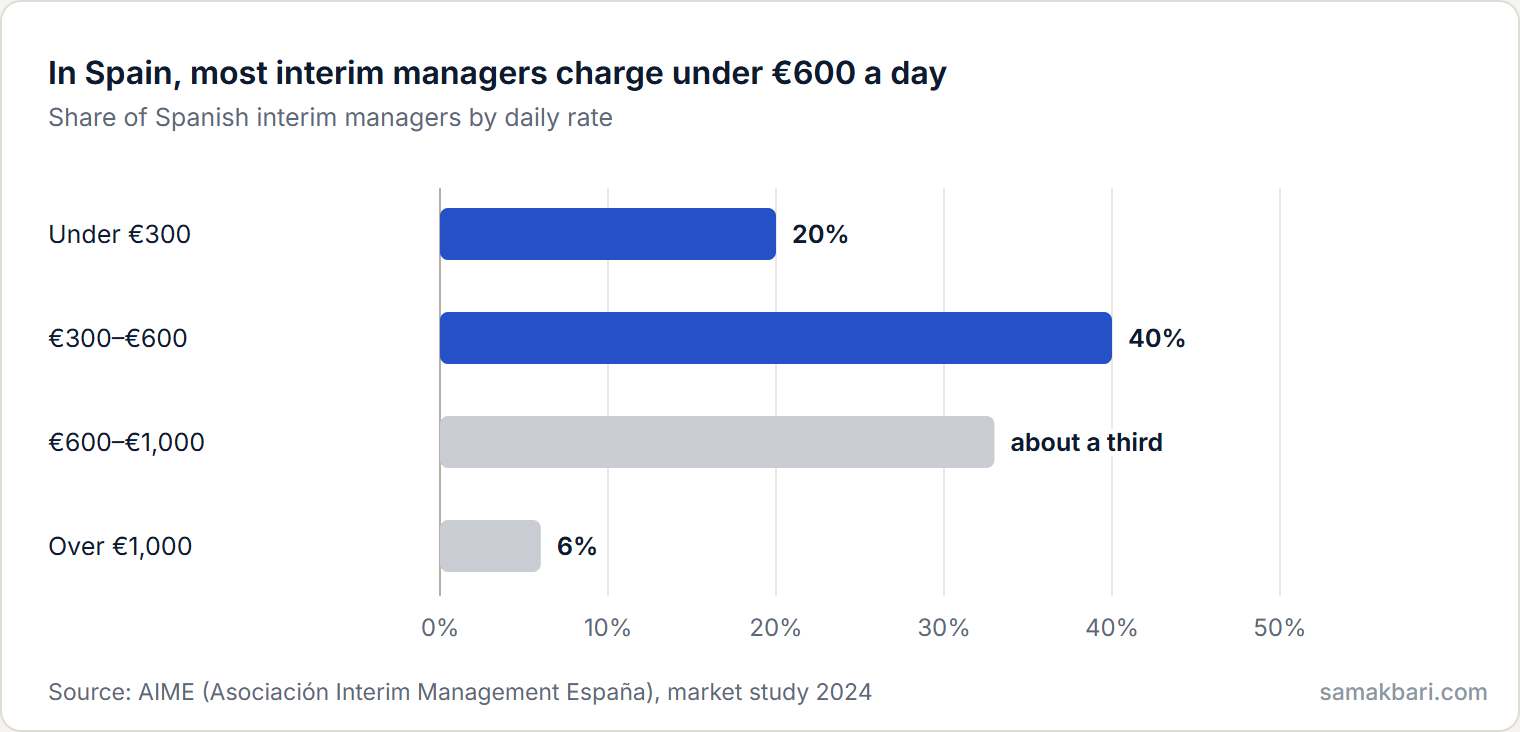
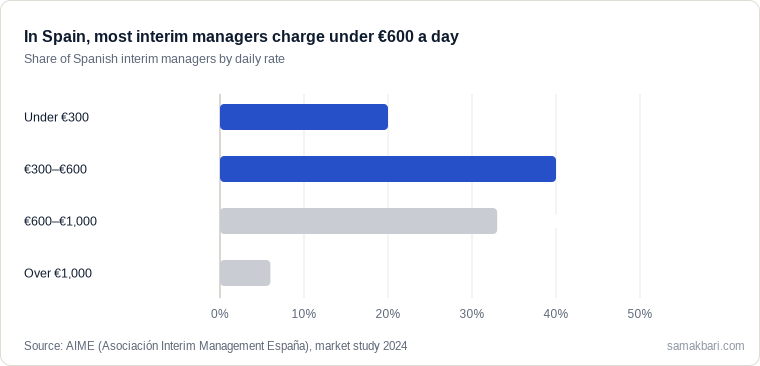
Averages hide a wide spread, and Spain shows it best. In the AIME 2024 market study, the survey of the Spanish interim management association, 20% of interim managers charged under €300 a day and only 6% more than €1,000. The typical respondent works for smaller and family businesses with fewer than 100 staff and under €20 million in revenue, which pulls the average down. (The same study put the Spanish average above €600; it predates the 2025 fall in rates.) An interim CEO for a private equity portfolio company is priced near the top of the range, not at the average.
For the detailed local guides, with worked examples in euro, see the Italian price guide and the Spanish price guide.
Is an interim manager cheaper than hiring a permanent executive?
By the day, no. Over the year, it depends on how long you need them and how many days a week.
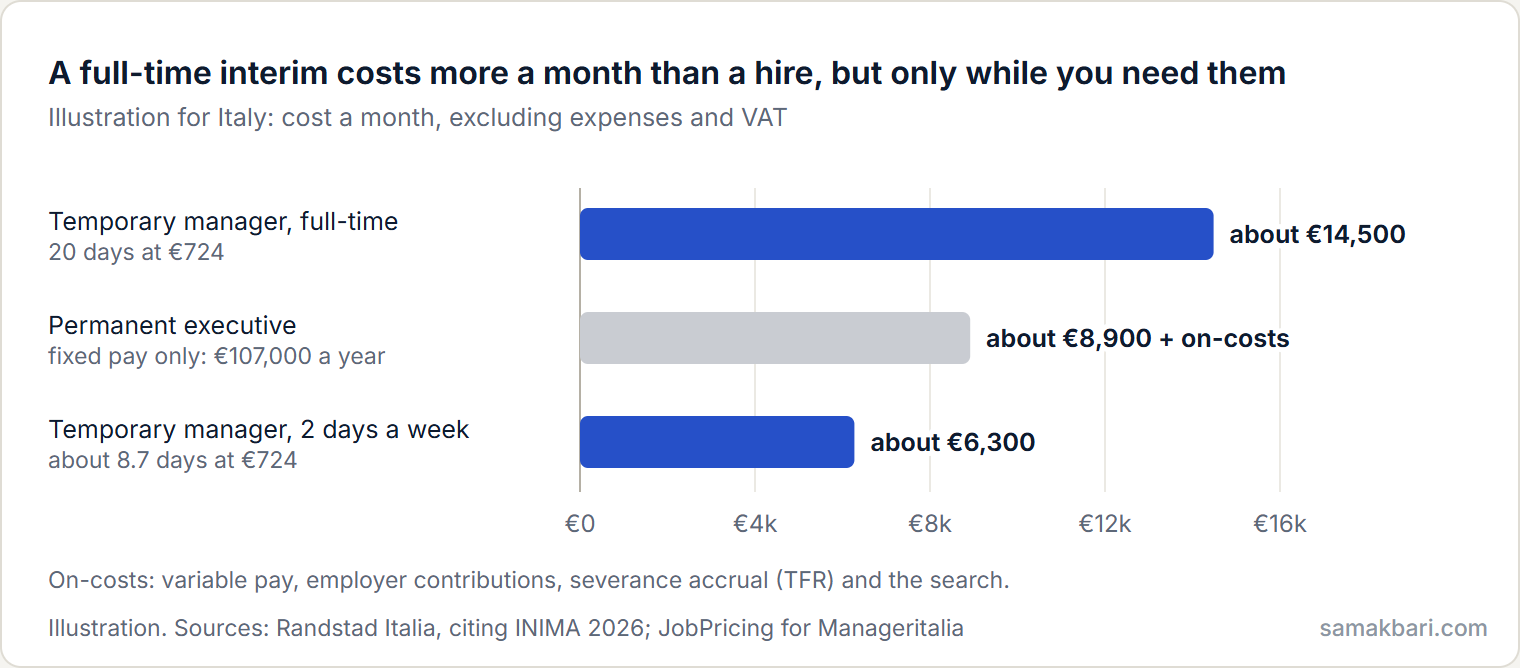
Take Italy, where the comparison is easiest to source. A permanent executive (dirigente) in a medium-sized company earns about €107,000 a year in fixed pay (JobPricing for Manageritalia), or about €8,900 a month, before variable pay, employer contributions, severance accrual (TFR) and the cost of a search. A full-time temporary manager at the €724 average costs about €14,500 a month. Two days a week costs about €6,300.
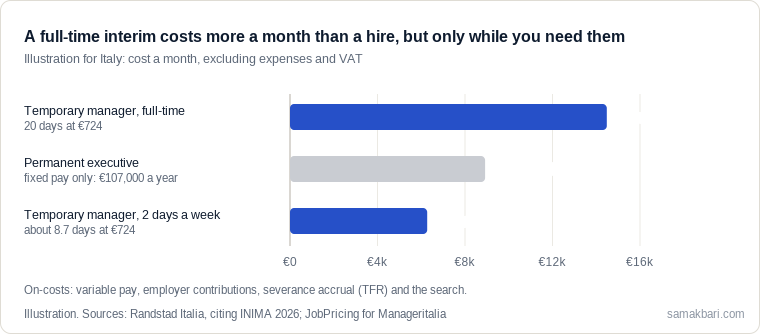
So the full-time interim costs more per month, and you pay it only for the months you need. What you’re really buying is time and a lower risk of a wrong hire. The managing partner of Valtus Italia, an interim provider, told Il Sole 24 Ore that an interim manager can be in place in 5–10 days, against 4–6 months for an executive search. That’s a provider’s view, but the gap is real: a search takes months before anyone starts.
In Spain the arithmetic is similar. Michael Page’s salary guide puts a C-level salary at €100,000–€200,000 a year (Michael Page Spain), before employer social security, against €10,000–€26,000 a month for a full-time interim depending on the level.
How does an assignment work in practice?
Most assignments follow the same five steps.
- Write the mandate. What has to be true at the end, by when, which decisions the manager owns (hiring, spending, suppliers) and who they report to. A one-page brief is enough; I use this brief template.
- Find the person. In Italy, 58% of assignments still come through personal networks and 25% through specialist providers (Randstad Italia, citing INIMA 2026). Providers add a margin but bring a vetted shortlist quickly.
- Sign the contract. Usually a services contract with the manager’s company (see the next section), with the days, the fee, expenses and the notice period.
- Start fast. The first weeks are about understanding the numbers and the people, and taking the decisions that can’t wait.
- Hand over. To a permanent hire, or to the team once the program is delivered.
Plan for about a year. The European average was 10.8 months in 2025 (INIMA 2026). In Italy more than 60% of assignments now run past 12 months and 25% past 24 months (Randstad Italia), and Spanish interim managers report assignments of 11 to 24 months (AIME 2024).
Employee or contractor: how is a temporary manager hired?
In both countries the usual route is a services contract with the manager’s own company or with a self-employed professional. In both, the law looks at how the work is actually done, not at the contract’s name.
| Italy | Spain | |
|---|---|---|
| The usual contract | A services contract (contratto d’opera, art. 2222 of the Civil Code) with the manager’s company or VAT-registered practice | A commercial services contract (contrato mercantil) with the manager’s company or as a self-employed professional |
| The risk to manage | A personal, ongoing collaboration whose working arrangements the client organises is treated as employment (art. 2, Legislative Decree 81/2015) | Work for and under the organisation and direction of another is presumed to be employment (Workers’ Statute, art. 8.1); a contractor earning at least 75% of their income from one client has a special status (Law 20/2007) |
| If you need an employee | A fixed-term executive contract of up to five years (art. 29, Legislative Decree 81/2015) | The special senior management relationship (Royal Decree 1382/1985) |
What keeps a services contract genuine is the same in both countries, and in Australia: a defined scope, agreed days, the manager’s own business with other clients and insurance, and no direction of how they do the work. I cover the detail in Italian and Spanish, and the Australian version in is a fractional executive an employee or a contractor?. This is general information, not legal advice.
One Italian development to watch: a bill before the Italian Chamber of Deputies, C. 2474, proposes a tax credit on the cost of a temporary manager of 30% for micro and small companies and 20% for medium ones (ItaliaOggi, 2 October 2026). It’s a proposal under review by the Finance committee, not law, so don’t budget for it yet.
Is interim management growing in Italy and Spain?
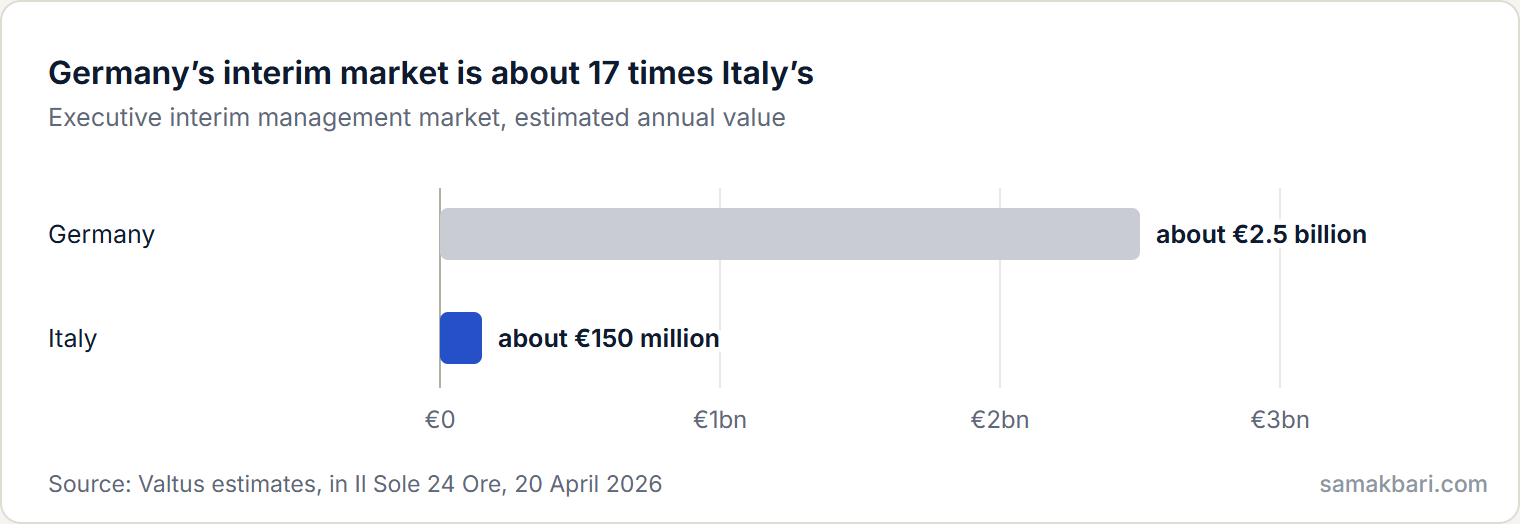
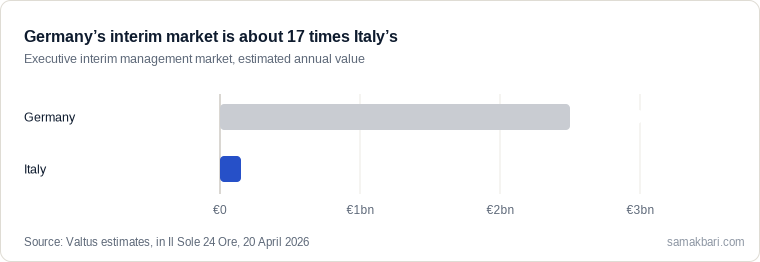
Italy is a small market with room to grow. Valtus estimates executive interim management at about €150 million a year in Italy against about €2.5 billion in Germany (Il Sole 24 Ore, April 2026), and expects Italy to grow at about 15%.
The wider European market cooled in 2025: the average day rate fell slightly and the average assignment shortened by 0.7 months (INIMA 2026). For a buyer that means more choice and room to negotiate, particularly in Spain.
Where a fractional executive fits
An interim manager works full-time. A fractional executive does the same kind of job one to three days a week, for longer. Italy is already moving that way: 49% of Italian assignments were part-time in the 2026 survey, as reported by Randstad Italia.
That’s how I work in Italy and Spain: as a fractional CRO/CMO, COO or Chief AI Officer, in English, in person with notice for travel or remotely from Melbourne, which starts much sooner. My fractional seats start from A$12,000 a month (my Italian and Spanish pages show the euro equivalent), and full-time interim roles are quoted after a call. It suits companies whose leadership already works in English: subsidiaries of international groups, private equity portfolio companies and export-led businesses. I’ve led a global P&L of about A$15 million as CRO/CMO of an ASX-listed technology company and built go-to-market across Asia-Pacific, Europe and the Americas, so a subsidiary reporting to a head office abroad is familiar ground.
The bottom line
A temporary manager in Italy and an interim manager in Spain are the same tool: senior leadership for a defined period, usually about a year, at about €724 a day in Italy and a little over €500 in Spain on average, through a services contract with the manager’s company. Write the mandate first, keep the contract genuine, and decide early whether you need someone full-time or one or two days a week.
If you’re weighing up either for an Italian or Spanish business, book a 30-minute call. I’ll tell you honestly whether you need an interim, a fractional executive or a permanent hire.
Common questions
What is the difference between a temporary manager and an interim manager?
None in substance. Italy calls the role a temporary manager and the practice temporary management; Spain, like most of Europe, calls it an interim manager. Both are senior executives who take a leadership role for a defined period with real authority, then hand over.
How much does a temporary manager cost in Italy?
The average day rate in Italy was €724 in the 2026 survey of European interim manager associations, as reported by Randstad Italia, with a range from about €500 for specialist roles in smaller companies to €1,500–€2,000 for C-level roles in mid-caps. Full-time, at about 20 days a month, €724 a day comes to about €14,500 a month, excluding expenses and VAT.
How much does an interim manager cost in Spain?
Less than in Italy on average. Manager in Motion publishes €500–€800 a day for a functional director and €800–€1,300 for an interim CEO or general manager. In the AIME 2024 study, 40% of Spanish interim managers charged €300–€600 a day and about a third €600–€1,000.
How long does an interim assignment last in Italy and Spain?
Usually about a year, often longer. The European average in the 2026 survey was 10.8 months; in Italy more than 60% of assignments now run past 12 months and 25% past 24 months, and Spanish interim managers report assignments of 11 to 24 months.
Is a temporary or interim manager an employee?
Usually not. Most work through their own company or as a self-employed professional under a services contract. Both countries look at how the work is actually done, not at the contract's name, so set up a defined scope, agreed days and the manager's own business. For a full-time executive under the CEO's direction, Italy allows a fixed-term executive contract of up to five years and Spain has a special senior management contract.
Can an interim manager in Italy or Spain work in English?
Yes, if the business does. I work in English, so my engagements suit Italian and Spanish subsidiaries of international groups, private equity portfolio companies, export-led businesses and boards that already work in English.