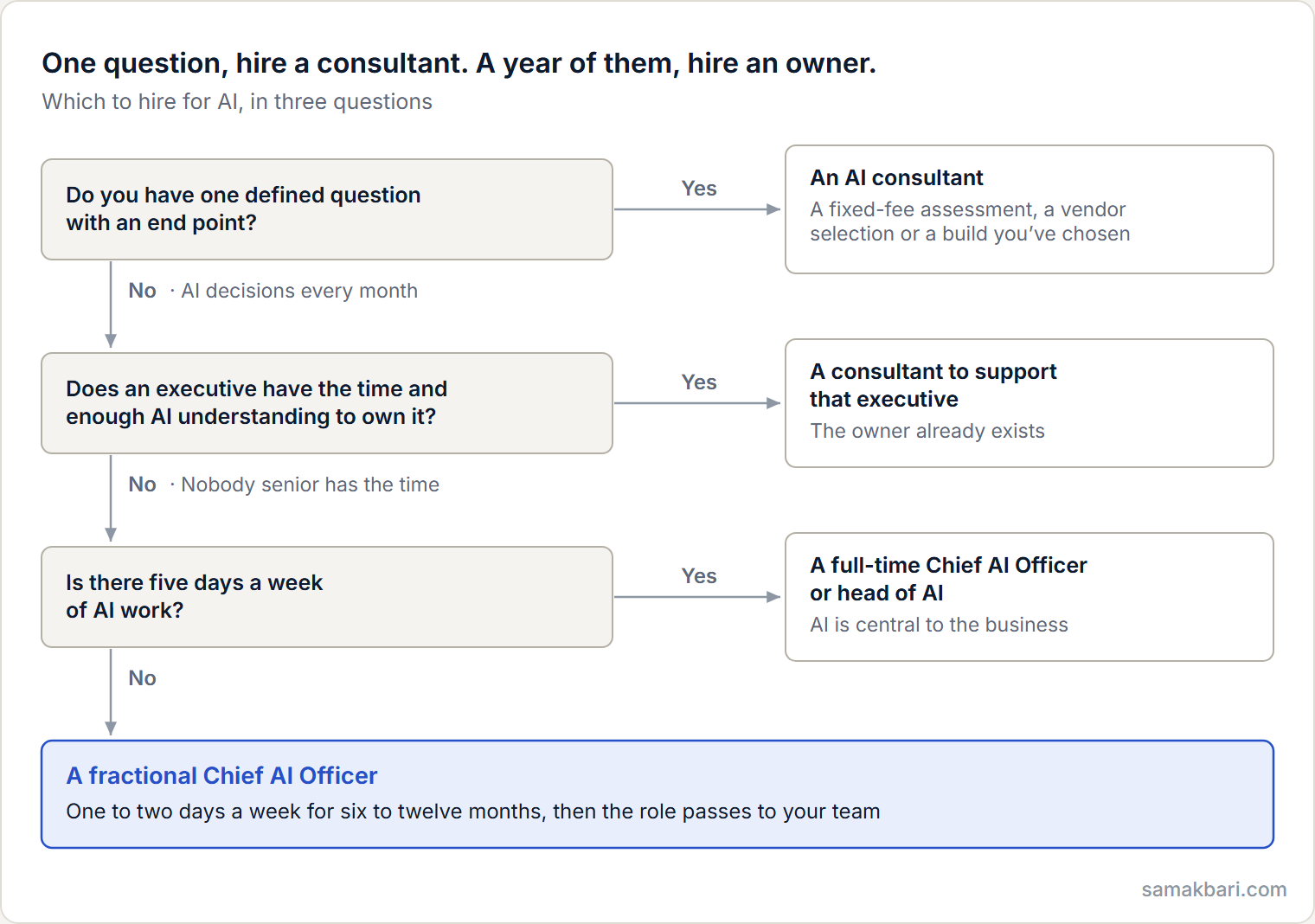
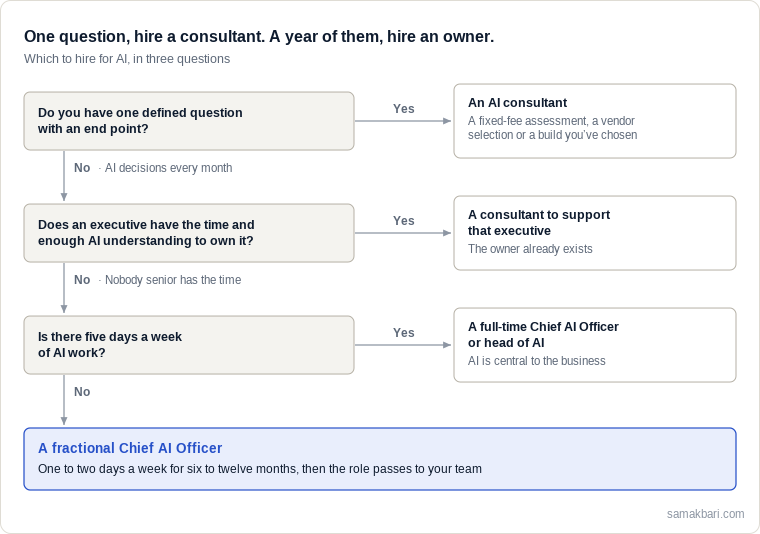
Short answer: hire an AI consultant when you have one defined question: where to start, which vendor to choose, whether a business case stacks up, or a build you’ve already decided on. Hire a fractional Chief AI Officer when AI needs an owner: someone in your leadership team who sets the roadmap, gets use cases into production, runs governance and answers to the board for six to twelve months. If you’ll still need someone to make AI decisions every month after the report lands, you need the second.
I take on both kinds of work, as an AI consultant in Melbourne and as a fractional Chief AI Officer, so I have no reason to push you towards one. I’ve also been the founder and CEO of a systems integrator, on the side of the table that’s paid to build what the client has chosen. Most of the disappointment I see with AI spending comes from buying a project when the business needed an owner, or the other way around.
I wrote about the general version of this choice in fractional executive vs consultant. AI has its own twists: the word “consultant” covers very different businesses, and Australian guidance now says plainly that someone senior has to own AI.
What does an AI consultant actually do?
“AI consultant” is one of the loosest titles in the market. Before you compare it with anything, work out which of three businesses you’re talking to.
| Type | What they sell | How they make money | Good for |
|---|---|---|---|
| Strategy or advisory consultant | Assessments, use-case selection, business cases, vendor selection | Fixed fee or day rate | An independent answer to a defined question |
| Implementation partner or integrator | Building agents, automations and integrations on your systems | Project fees, often followed by support contracts | Building something you’ve already chosen |
| Vendor-aligned consultant | Advice that leads to a platform, licence or managed service | Margin on the software or the build that follows | Getting a specific product working well |
None of these is wrong. The third is the one to understand before you sign, because the advice is cheap for a reason. When a strategy leads naturally to the platform the adviser resells, ask what they would recommend if they sold nothing. My AI vendor due diligence questions cover how to ask.
What all three have in common is that the engagement ends. The consultant delivers the output and leaves, and somebody inside your business has to decide what happens next.
What does a fractional Chief AI Officer do that a consultant doesn’t?
A fractional Chief AI Officer is an executive, not a supplier. They sit in your leadership team, usually one to two days a week, and they’re measured on what changes in the business.
| AI consultant | Fractional Chief AI Officer | |
|---|---|---|
| What you’re buying | An output: an assessment, a strategy, a build | A role: ownership of AI across the business |
| Who owns the outcome | You do. The consultant owns the quality of the work | The Chief AI Officer, for results agreed with the CEO |
| Typical length | Two to twenty weeks | Six to twelve months, often longer |
| Governance | Can design the policy and register | Runs them, and reports on them to the board |
| Other suppliers | Is one of them | Briefs, selects and holds them to account |
| Says no to AI projects | Depends on whether they sell what comes next | Part of the job |
| How it’s paid | Fixed fee, milestones or day rates | Monthly retainer for a set number of days |
| How it ends | The deliverable is handed over | The role passes to your team or a permanent hire |
Two rows matter most. The first is suppliers. Once you’ve decided to use AI seriously, you’ll be dealing with software vendors, an integrator, perhaps a data partner. Someone on your side needs to brief them, judge their work and push back. A consultant is one of those suppliers. A Chief AI Officer manages them.
The second is saying no. One of the most useful calls I’ve made on a technology program was a no: on a digital program at a global consumer brand, I recommended stopping a project that was already under way, which avoided more than US$1M in capital spending and about US$600,000 a year in running costs (case study). That call is hard to make from outside the business, and harder still if you’re paid for the build.
Who should own AI in your business?
This is where AI differs from most consulting questions, because the government has answered part of it.
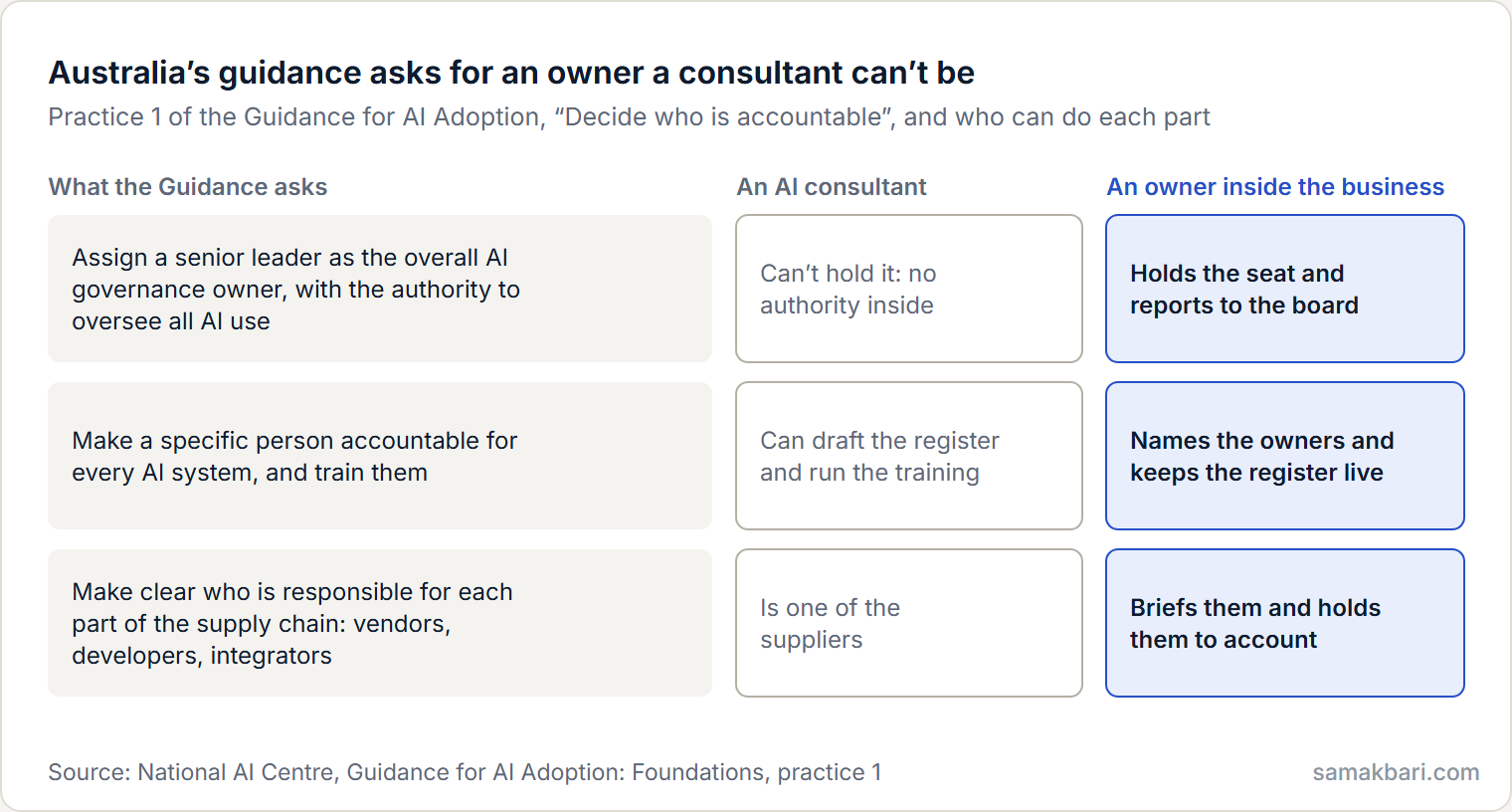
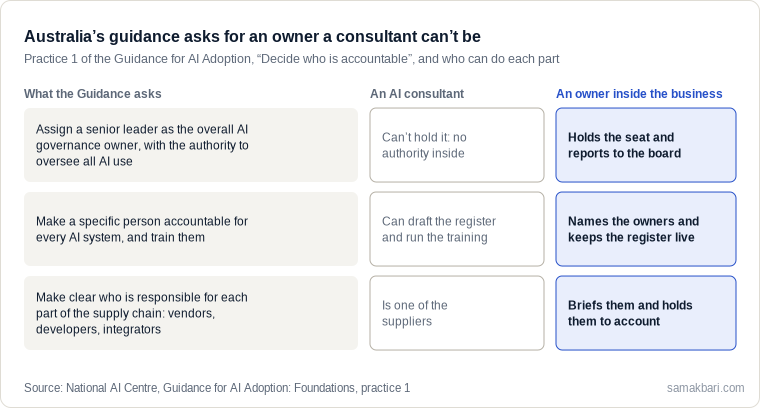
The first of the six essential practices in Australia’s Guidance for AI Adoption is “Decide who is accountable”. The first action it lists is to assign a senior leader as the overall AI governance owner, with enough authority and understanding to oversee all AI use in the organisation. Its next steps go further: make a specific person accountable for every AI system you use, and when vendors, developers and integrators are involved, make clear who is responsible for each part of the supply chain.
Directors are being told the same thing. The AICD and the Human Technology Institute at UTS updated A Director’s Guide to AI Governance in June 2026, noting that AI is now firmly embedded in many Australian organisations, often with significant investment, and that the board’s job is to govern the balance between opportunity and risk. A board can only do that if someone in management is reporting to it on AI.
Read those together and a consultant can’t fill the gap on their own. A consultant can write your AI policy, set up the register and train your people. They can’t be the senior leader accountable for all AI use, because they don’t hold authority inside the business and they’ll be gone in eight weeks.
That leaves three options for the owner:
- An existing executive takes it on, often the CFO, COO or CTO. That works if they have the time and enough understanding of AI to judge what they’re told.
- A fractional Chief AI Officer holds it for six to twelve months, then hands it to someone inside.
- A full-time Chief AI Officer or head of AI, once there’s five days a week of work. My Chief AI Officer guide covers when that day comes.
If option one works for you, a consultant to support that executive may be all you need. If nobody senior has the time, that’s the gap a fractional seat is for.
Which do you need? Match it to your situation
| Your situation | What to hire | Why |
|---|---|---|
| “We don’t know where AI would pay back” | A consultant, for a fixed-fee assessment | It’s one question with a clear end point |
| “We’ve chosen the use case and need it built” | An implementation partner, with someone on your side to own it | Building is their strength. Ownership isn’t |
| “The board keeps asking what our AI plan is” | A fractional Chief AI Officer | The board needs an owner who reports regularly, not a single report |
| “Pilots keep stalling before production” | A fractional Chief AI Officer | Stalled pilots are usually an ownership problem, not a technical one |
| “Staff use AI tools and we have no policy” | Either, depending on who will run it | A consultant can write it. Someone inside has to run it |
| “Three vendors are pitching us AI platforms” | A consultant for the selection, if there’s an owner. Otherwise a fractional Chief AI Officer | Someone independent has to judge the pitches |
| “We have one AI project and a capable CTO” | A consultant, to support the CTO | The owner already exists |
| “AI is central to our product” | A full-time Chief AI Officer or head of AI | There’s enough work for five days a week |
A rough rule: one question, hire a consultant. A list of questions that will keep coming for a year, hire an owner.
What does each cost in Australia?
I’ve covered the full figures in two guides, so here’s the summary.
| Option | Typical cost (AUD) | Source |
|---|---|---|
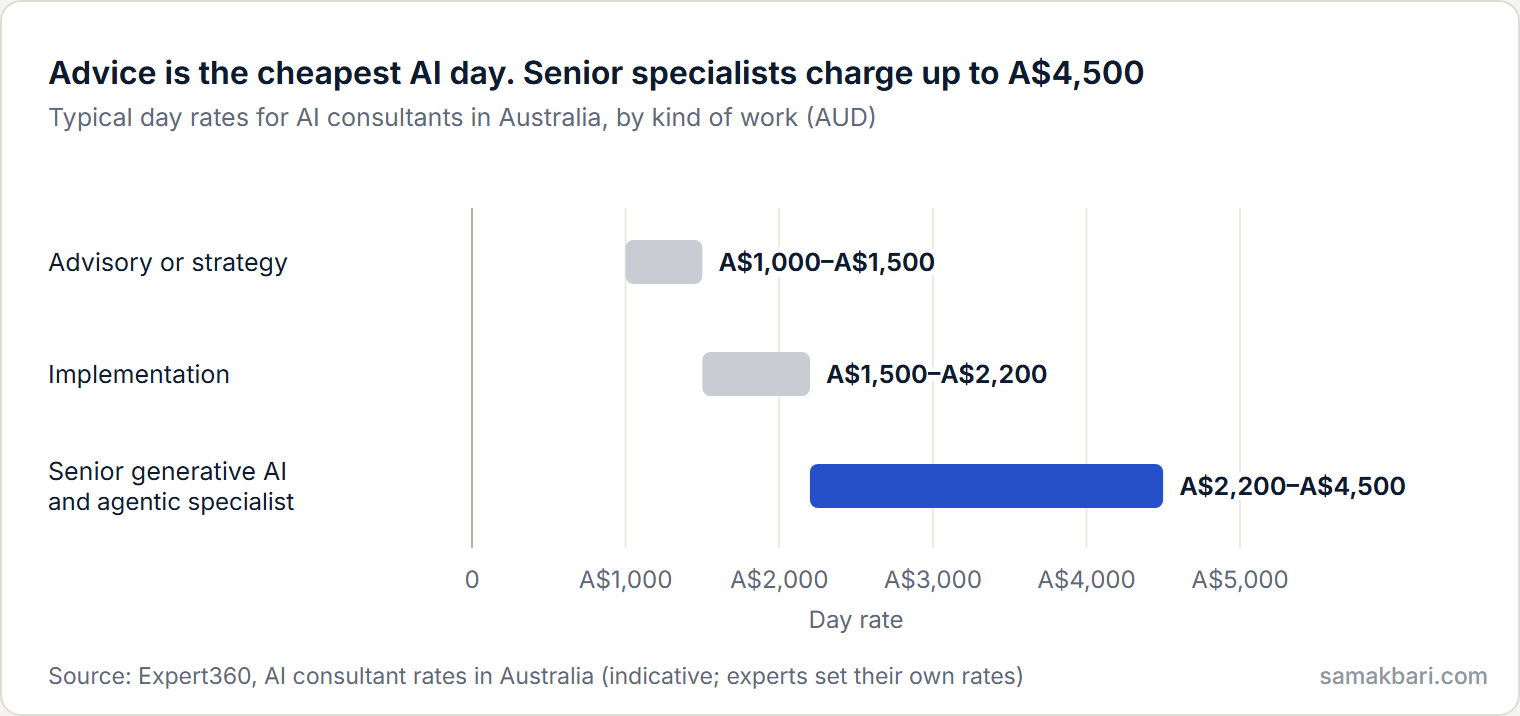
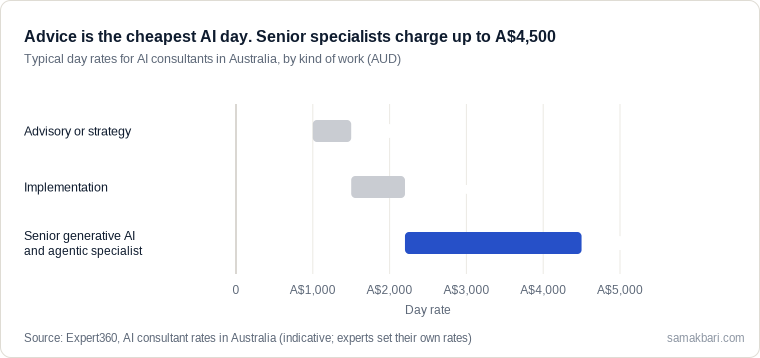
| AI advisory or strategy consultant | A$1,000–A$1,500 a day | Expert360 |
| AI implementation consultant | A$1,500–A$2,200 a day | Expert360 |
| Senior generative AI and agentic specialist | A$2,200–A$4,500 a day | Expert360 |
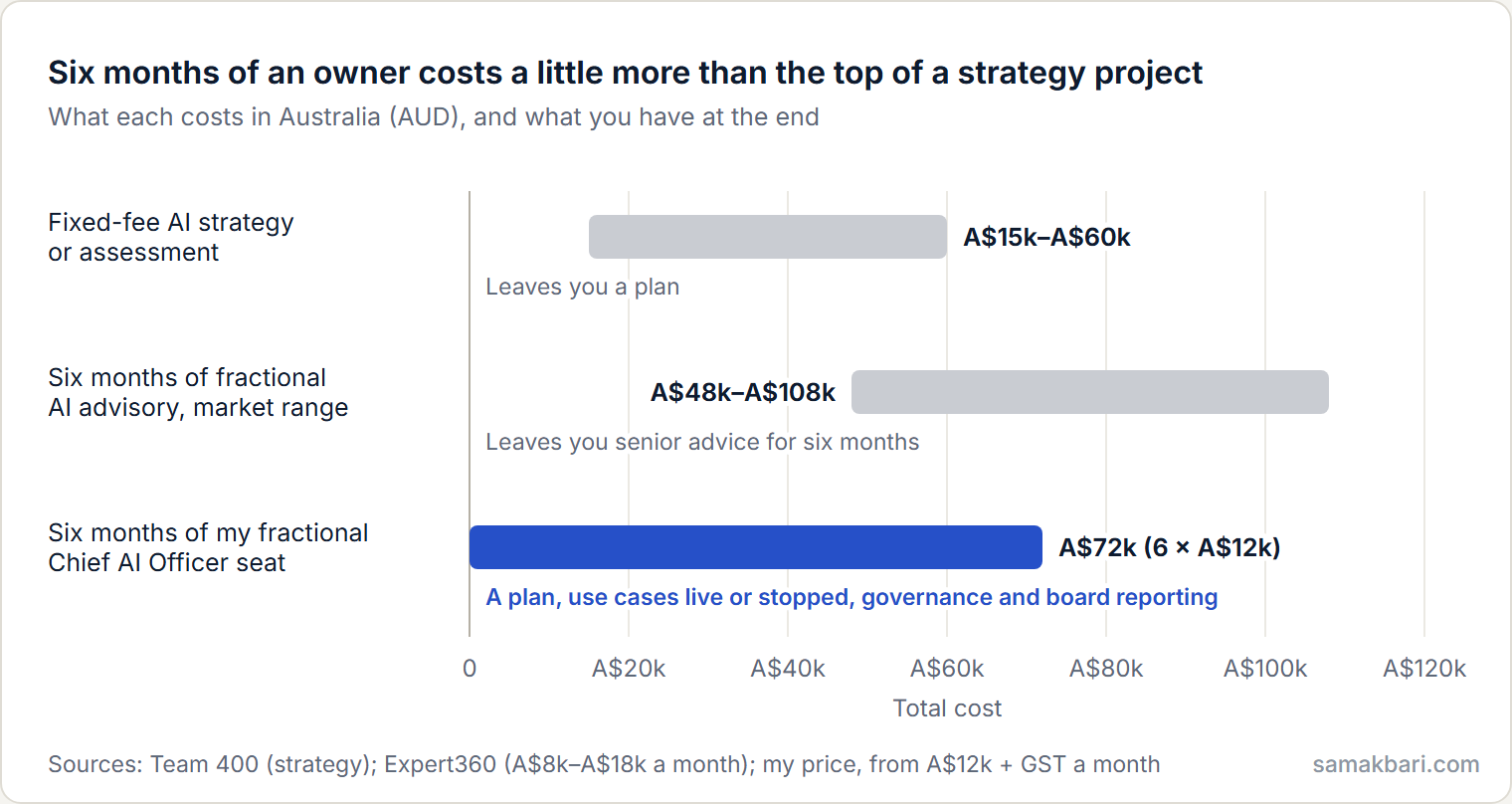
| Fixed-fee AI strategy or assessment | A$15,000–A$60,000 | Team 400, in my AI consultant cost guide |
| A defined AI build | From about A$20,000 to A$500,000 or more | Expert360 |
| Fractional AI advisory, one to three days a week | A$8,000–A$18,000 a month | Expert360. For a fractional Chief AI Officer, see my cost guide |
| Permanent senior AI lead | About A$200,000–A$280,000 base salary, after a three-to-six-month search | Expert360 |
Expert360 is a consulting marketplace and says its rates are indicative, because experts set their own. Team 400 is a boutique AI consultancy that works mainly on Microsoft platforms. Neither says whether its figures include GST.
My own prices sit inside those ranges: an AI readiness diagnostic from A$15,000 + GST for about two weeks, a fractional Chief AI Officer seat from A$12,000 + GST a month for about one day a week, and an advisory retainer from A$5,000 + GST a month for one to two days a month.
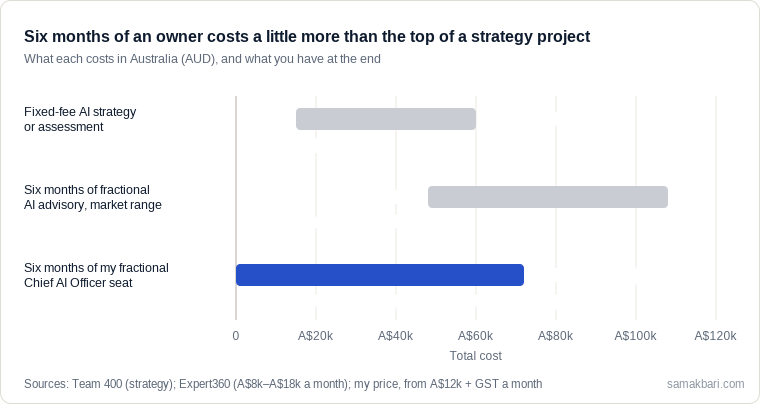
The invoices aren’t the real comparison. Six months of a fractional seat at A$12,000 a month is A$72,000, a little above the top of the range for a strategy project. One leaves you a plan. The other leaves you a plan, two or three use cases in production or deliberately stopped, a working governance process and a board that has had six months of reporting. At Expert360’s A$8,000–A$18,000 a month, six months of fractional AI advisory comes to A$48,000–A$108,000. If you buy the strategy, budget for whoever will own it afterwards.
Can a consultant and a fractional Chief AI Officer work together?
Yes, and for most mid-market companies that’s the best arrangement. The Chief AI Officer owns the roadmap and the governance, and brings in consultants and integrators for specialist work, with a clear brief and someone ready to act on the answer.
It also makes the supply chain accountability the Guidance asks for straightforward. With an owner in place, every vendor and integrator knows who they report to, what they’re responsible for and how their work will be judged.
The sequence I use myself is diagnose, then own. A short, fixed-fee diagnostic finds where AI would pay back and what’s in the way, and ends with a 90-day plan. Sometimes that plan says you need a fractional seat. Sometimes it says an existing executive can own AI with a little support, which is a useful answer too.
Ownership is also what makes results last. In my AI translation work at a global consumer brand, moving translation to an AI-first workflow across 14 languages saved about US$1M a year (case study). Results like that depend on someone inside the business owning the change, the suppliers and the workflow, long after any single piece of advice.
Warning signs on either side
When you’re hiring an AI consultant
- The recommendation happens to match the platform they resell.
- The proposal says what they’ll do, but not what you’ll have at the end: a decision, a business case, a working system.
- Nobody has asked who in your business will own the result.
When you’re hiring a fractional Chief AI Officer
- It’s a consultant with a bigger title: a strategy document in month one and little after it. Ask what they owned in their last role, and what changed.
- They’ve never put AI into production themselves, or can’t name what they decided not to build.
- There’s no end point. A good engagement plans its own handover from the first month.
The bottom line
An AI consultant gives you an answer. A fractional Chief AI Officer gives you an owner. Australian guidance now expects every organisation using AI to have a senior leader accountable for it, so the real question is who that person is. If you have one, a consultant can support them. If you don’t, that’s the gap to fill first.
If you’re not sure which you need, take the free AI Readiness Scorecard or book a 30-minute call. I’ll tell you whether it’s a fixed-fee diagnostic, a fractional Chief AI Officer, or neither yet.
Common questions
What is the difference between an AI consultant and a fractional Chief AI Officer?
An AI consultant is engaged for a defined piece of work, such as an assessment, a vendor selection or a build, and leaves when it's delivered. A fractional Chief AI Officer holds a seat in your leadership team part-time, usually one to two days a week, and owns the AI roadmap, governance and results for six to twelve months or longer. The test is who answers for AI in your business a year from now.
Is a fractional Chief AI Officer more expensive than an AI consultant?
Per engagement, often yes. Per result, often no. A fixed-fee AI strategy typically costs A$15,000–A$60,000, while fractional AI advisory runs about A$8,000–A$18,000 a month, and my fractional Chief AI Officer seat starts from A$12,000 + GST a month. The strategy is cheaper if you have one question. If you'll be making AI decisions every month for a year, paying for a series of strategies and builds with nobody owning them usually costs more.
Can an AI consultant be our AI governance owner?
Not really. The Australian Government's Guidance for AI Adoption asks organisations to assign a senior leader as the overall AI governance owner, with the authority to oversee all AI use. An outside consultant can design the policy and the register, but they don't have that authority inside your business. A fractional Chief AI Officer can hold the role, because they sit in the leadership team.
How long should a fractional Chief AI Officer engagement last?
Six to twelve months is typical. That's long enough to set a roadmap, get the first two or three use cases into production and put governance in place. The engagement should end with the role handed to someone inside the business, or with a clear case for a permanent hire.
Should we hire an AI consultant or an AI engineer first?
Decide what to build before you hire someone to build it. An engineer builds what they're asked to; the expensive mistakes are usually in choosing what to build. If you don't yet know which two or three uses of AI would pay back, start with a short, fixed-fee assessment, then hire the engineer.