Version 1.0, November 2026. This is a living thesis: the six predictions at the end are scored every November, and the charts are updated with them.
In six weeks this year, investors took about a trillion dollars off software companies. They were right about the direction and wrong about the shape. AI isn’t killing business software. It’s forcing it into the shape every other layer of computing already has: a few operating systems, and a lot of apps.
The thesis in four sentences. Within ten years, the biggest software decision a business makes will be which operating system it runs on. There will be roughly 30 to 40 of them, each strong in an industry, the way phones settled on iOS and Android. Almost everything else sold as software today, from marketing to rostering to analytics, becomes an app that lives inside one of them. And one player could collapse the forty into one: a frontier AI lab, with more compute and more daily business users than any software company, has a window of three to five years to become the operating system itself.
The test of who’s winning is simple. When the business pays, whose invoice is it?
I write from the buyer’s side of the table, as a fractional COO, CRO and Chief AI Officer to mid-market companies. This is a thesis, not a model. I make six dated predictions at the end and will score them every November.
The market has already voted
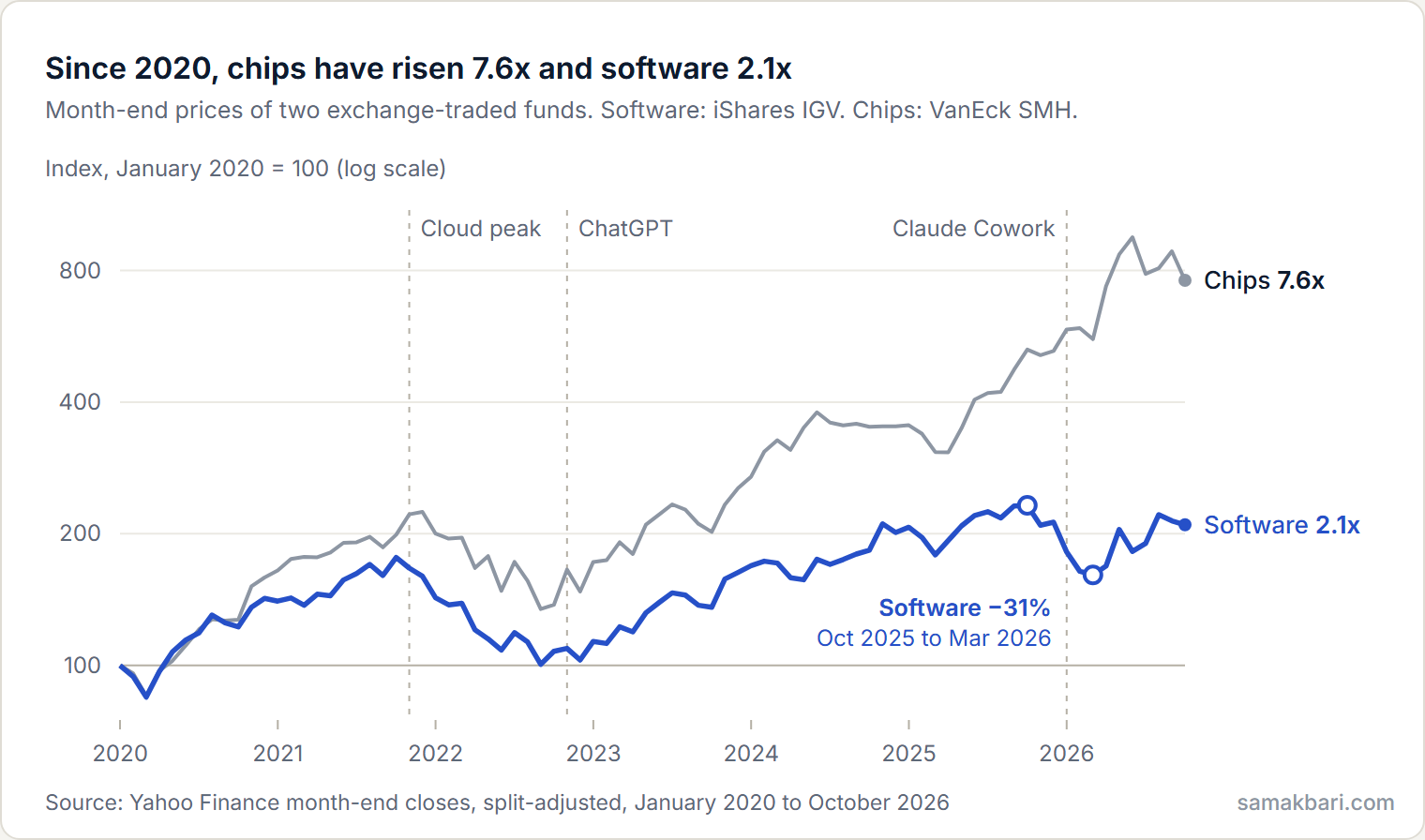
For six years, investors have paid for the picks and shovels of AI and not for the applications. From January 2020 to October 2026, an ETF of semiconductor companies rose 7.6 times. An ETF of software companies rose 2.1 times. Since the cloud peak of November 2021, chips are up more than threefold and software about a quarter.
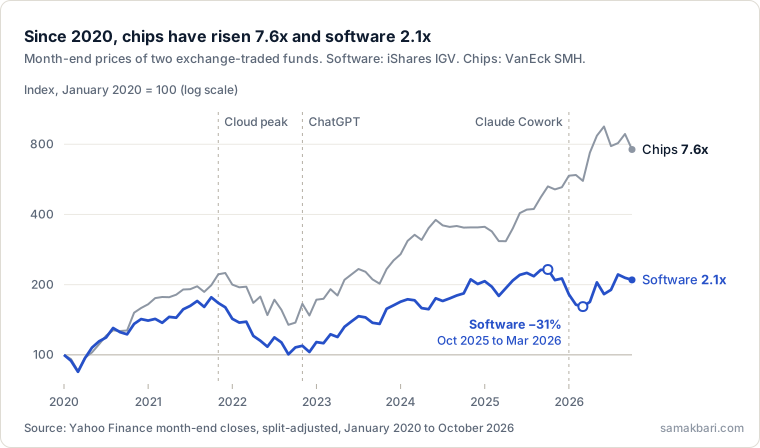
Then came the shock. Anthropic launched Claude Cowork on 12 January 2026 and, on 30 January, plugins that do legal, finance and marketing work. Between 12 January and 23 February the software ETF fell 27% (my calculation from Yahoo Finance closes), and it kept falling to a low on 10 April, 37% below its September 2025 peak (31% on the month-end prices in the chart). Reuters reported a trillion dollars lost in a week; other estimates ran to US$2 trillion. Ten application companies (Salesforce, Adobe, ServiceNow, Workday, Atlassian, HubSpot, Intuit, SAP, Shopify and Toast) lost US$518 billion of market value by 10 April, by my count from companiesmarketcap.com.
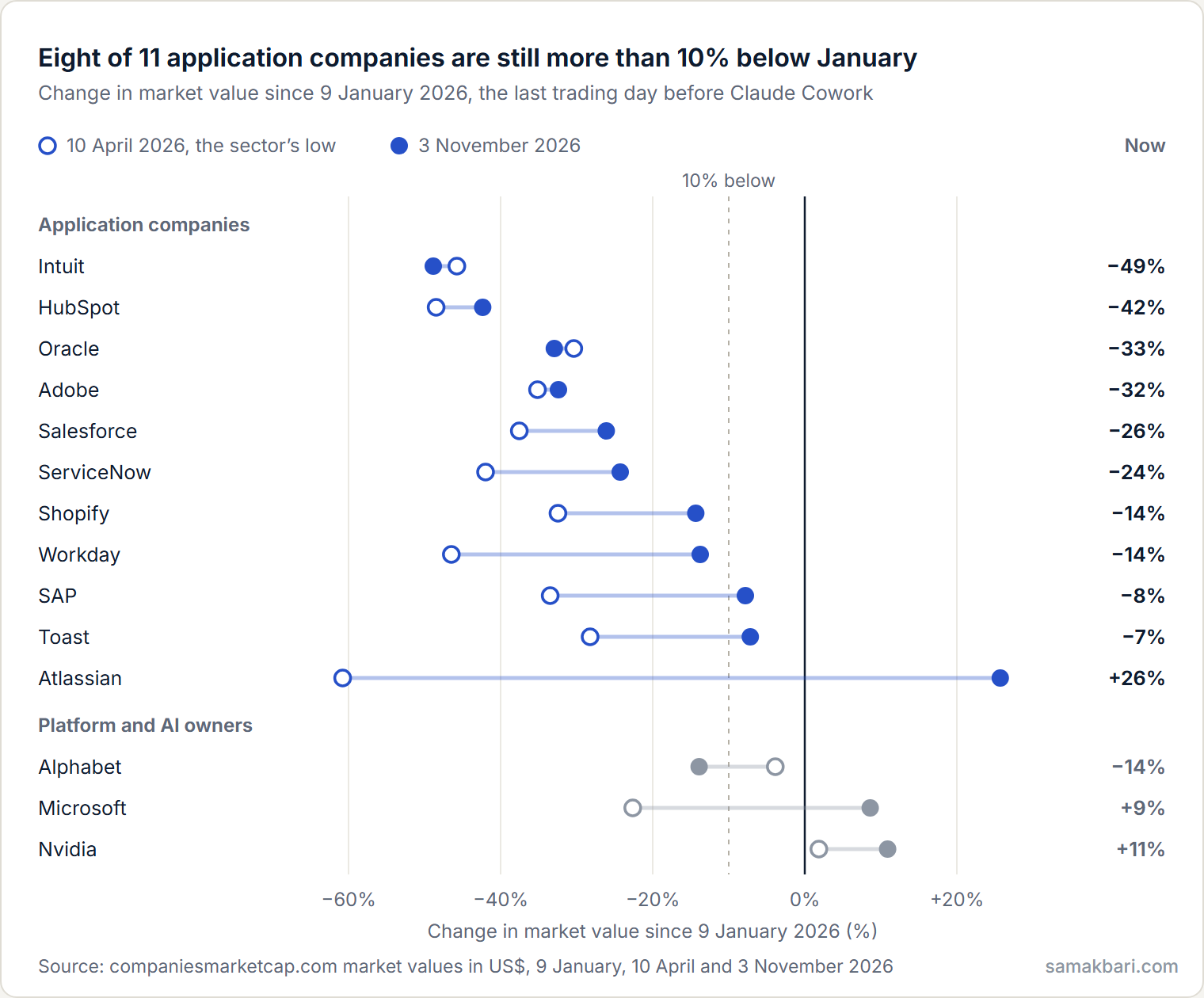
Since April, software has bounced: its best month since 2001 in May, and about two thirds of the fall won back. But look at who recovered.
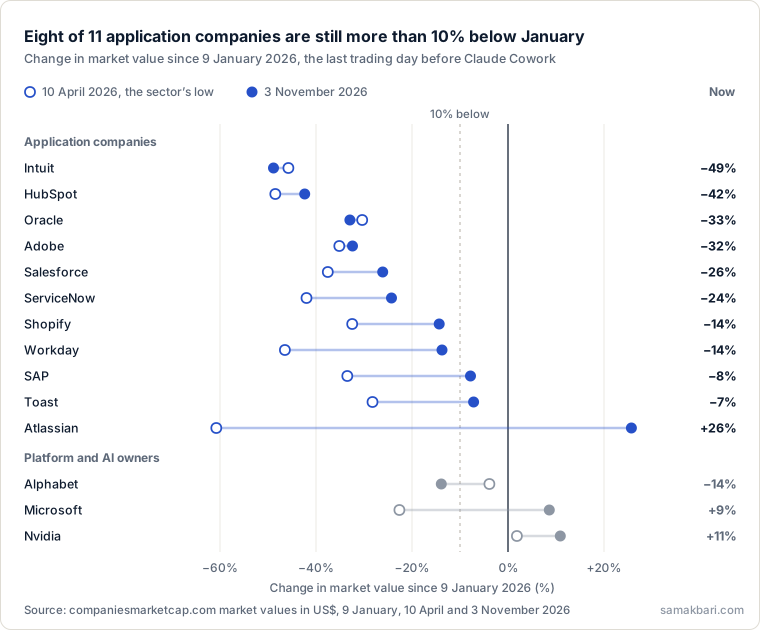
The companies that are worth more than in January own a dominant platform, as Microsoft does, or the infrastructure of AI, as Nvidia does. Most of the companies that sell applications are still a quarter to a half below. Much of their bounce came from buying back shares (Salesforce’s US$25 billion accelerated buyback), from takeover talk (Workday and Silver Lake), or from partnering with a lab (Salesforce’s “Claudeforce” deal with Anthropic). And it keeps reversing: ServiceNow fell 27% on 29 October, its worst day on record.
Shares swing like this when investors can’t agree what a company will be worth in ten years. The market’s message to an application company that owns neither its customers’ platform nor frontier AI is that it’s being priced as an app in waiting.
There’s a structural reason. Wherever a true platform exists, two or three players hold almost all of it: Android and iOS run 99.97% of phones, three companies hold 61% of cloud infrastructure, three labs take 95% of enterprise spending on AI models. In business applications, the leader of the biggest category, CRM, holds 20%, and no ERP vendor holds more than 7%. Business software is the one layer of computing that never consolidated. The appendix has the figures by layer.
The thesis: operating systems and the apps inside them
Before 2007, every handset maker shipped its own software, and a phone’s features were whatever the maker built. After the iPhone and Android, the buyer made one decision, the operating system, and everything else became an app. Nobody now compares calendar apps before choosing a phone. Business software is about to reorganise the same way.
A business operating system isn’t defined by having lots of features. It’s defined by owning five things the rest of the stack has to borrow:
- The core record of the industry. The job for a trades business, the patient for a clinic, the matter for a law firm, the order for a retailer.
- Identity and permissions. Who the staff, customers and suppliers are, and what each may see and do.
- The money. Payments, payroll, invoicing and, increasingly, lending.
- The runtime. Where workflows and AI agents run, with an audit trail of what they did.
- Distribution. A marketplace where apps are found, installed and billed.
An app borrows all five. It uses the operating system’s records, its users and its billing, and competes on depth in one job rather than breadth. A marketing product stops being a marketing platform and becomes the marketing app inside the restaurant operating system, or the construction one, or the clinic one.
This is already happening in pockets, which is why I’m confident it spreads:
- Toast, the restaurant platform, made US$5.0 billion of its US$6.2 billion 2025 revenue from payments and other financial products, about 82%, across roughly 164,000 locations. The software wins the restaurant. The money is how it earns.
- Shopify says its partner ecosystem generated US$6.86 for every dollar Shopify earned in 2025, and its app developers earned US$1.3 billion. Klaviyo, now one of the largest email marketing companies in the world, grew up as a Shopify app: 77.5% of its recurring revenue came from Shopify merchants when it listed, and Shopify had invested US$100 million in it.
- Rippling built HR, payroll, IT and spend management on one record of each employee, which its founder calls the employee graph. Each new product starts with data the customer already keeps there.
- Intuit paid US$12 billion for Mailchimp in 2021 to bring email marketing inside its small-business finance platform, rather than integrate with it from outside.
None of these companies set out to be one of forty operating systems. Each worked out that owning the record and the money, then letting others build on it, beats being one more platform in a crowded category.
Two futures, and the two camps
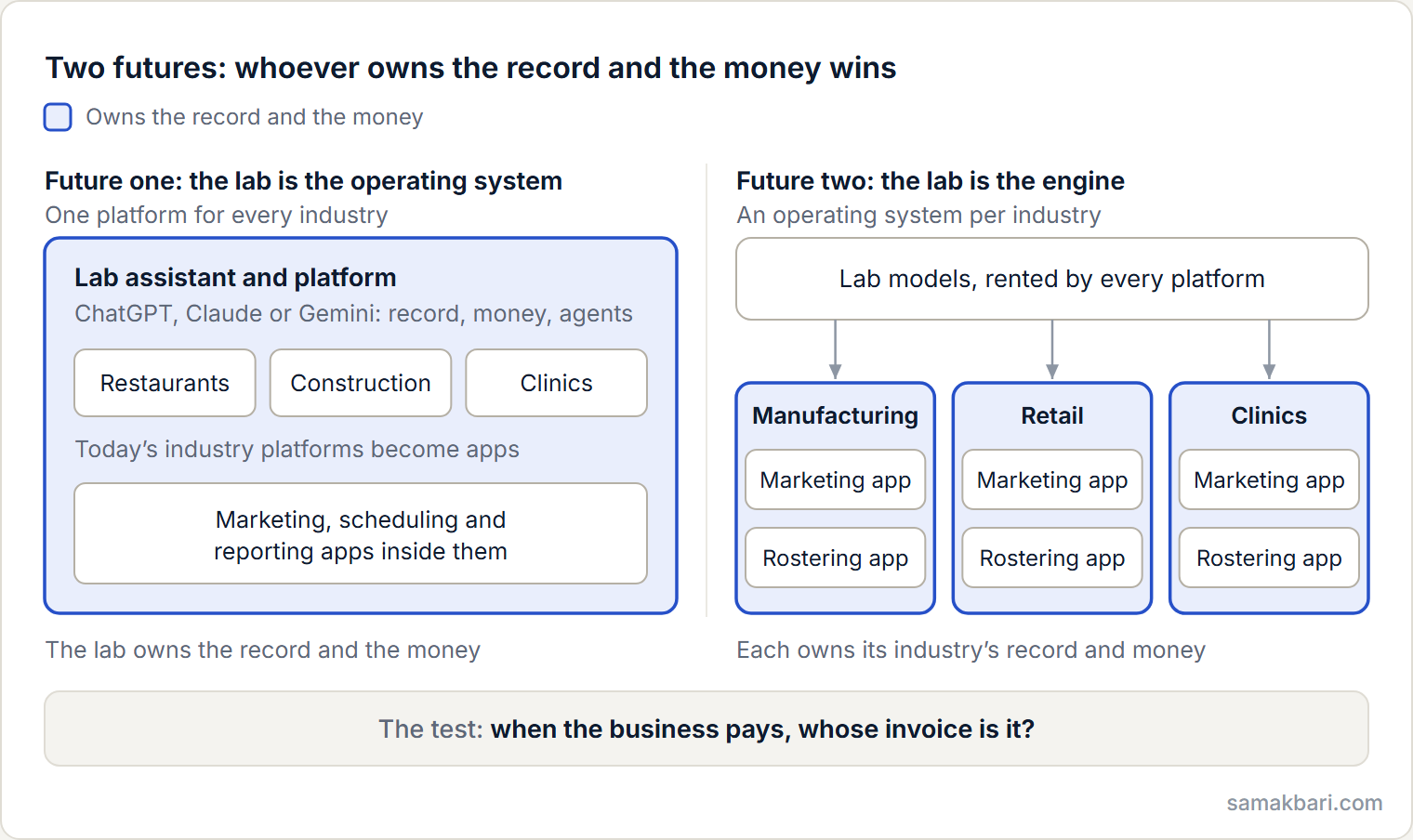
There is one player that could make the forty collapse into one or two: the frontier AI labs. OpenAI, Anthropic and Google have more compute, better models and more daily business users than any software company. Staff already open ChatGPT, Claude or Gemini before anything else in the morning. If a lab decides to become the operating system for business, the industry platforms become its apps. If none does, the industry platforms win, and we get a manufacturing operating system, a retail one, a clinic one and so on.
The debate already has two camps, and they map onto the two futures.
The “logic moves up” camp. In December 2024 Microsoft’s Satya Nadella told the BG2 podcast that business applications are essentially databases with business logic attached, and that the logic is moving into an “AI tier” of agents that work across many back ends. In this view the interface and the intelligence win, and the back end becomes a commodity. That’s future one.
The “record wins” camp. In August 2026 Salesforce and Anthropic announced Claudeforce, with Marc Benioff letting Claude be the front end to Salesforce’s data, which is in effect a bet that the system of record outlasts the interface. “This is not the SaaSpocalypse,” Benioff told analysts the next day. That’s future two: the lab as engine, rented by every platform, the way Intel sold chips to every PC maker.
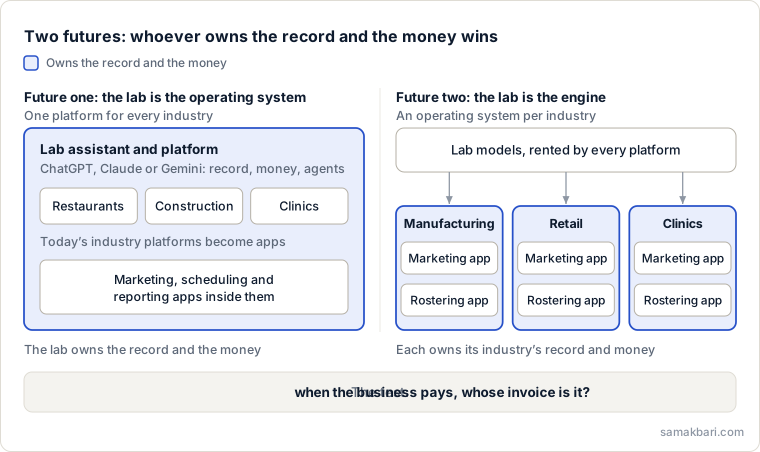
I think Nadella is right about the direction and Benioff is right about what’s scarce. An agent that issues refunds, books jobs or changes a roster needs one trusted record, one set of permissions and one audit trail. Agents don’t remove the need for a centre. They raise the price of not having one. So the question is not whether a centre exists but who owns it, and the labs are now building the parts:
- OpenAI opened apps inside ChatGPT in October 2025 and a directory for third-party apps in December; launched Frontier, a platform for running agents across a company’s existing systems, in February 2026; and in May created the OpenAI Deployment Company, with US$4 billion and 150 engineers to install AI inside businesses.
- Anthropic launched Claude Cowork in January 2026 with plugins for legal, finance and marketing work, then integrations with Docusign, FactSet, Google Workspace, Intuit and Salesforce, and in May a services venture with Blackstone, Hellman & Friedman and Goldman Sachs.
- Google launched Gemini Enterprise in October 2025, one subscription combining chat, search and a library of agents, with an agent-building platform following in 2026.
Every one of these is a runtime, a marketplace or a distribution channel: three of the five parts of an operating system. What none of them has yet is the record or the money. That’s the hard part: industry data models, health and privacy law, payment licences and support for workflows that don’t interest most AI researchers. And every industry platform is currently a lab customer. A lab that competes with its customers gives them a reason to buy from a rival.
My view is that the labs have three to five years. An operating system is expensive to leave once a business’s core records live in it, so whoever holds the record by the end of the decade will be hard to move. If the labs don’t take that ground in time, the industry operating systems will, with the labs’ models inside them.
Four signs would show future one arriving:
- A lab launching payments, payroll or lending for businesses.
- A lab buying an industry platform outright.
- A lab offering a system of record (a database for customers, jobs or orders), not only connectors to other people’s.
- Published revenue-share terms for business apps inside a lab’s product.
Why ERP missed its chance
The obvious question is why this didn’t happen thirty years ago. ERP software from SAP, Oracle and Microsoft Dynamics already holds most of what an operating system needs: the ledger, the supply chain, procurement, HR and payroll, across every business unit.
In my view it missed the chance because it was built for functionality, not for people. ERP assumes an expert at the keyboard. Configuring it takes certified consultants, implementing it is a programme measured in years, and using it well takes something close to a degree in the product. Queensland Health contracted an SAP payroll system for A$6.19 million; after 2,500 customisations, KPMG forecast the bill at A$1.25 billion. Lidl walked away from an SAP project after seven years and about €500 million. Birmingham City Council’s Oracle system, budgeted at £19 million, is forecast at £144 million and still isn’t finished. When fitting the software costs more than the software, it can’t be what every business runs on. Staff work around it in spreadsheets, and every gap becomes a market for another SaaS product. ERP never built the second half of an operating system either: its partner network is consultancies, and its “apps” are customisations. After fifty years, no ERP vendor holds more than 7% of the market.
This is where AI changes the equation. The complexity a consultant used to absorb, the software can now absorb itself. Setting up a business can be a conversation rather than a configuration project, and agents can carry data between finance, operations, sales and HR and explain it in plain language to anyone who asks. For the first time it’s possible to build what ERP should have been: one system that brings every business unit onto one record, handles complex requirements, and is easy enough for an owner to run, with an app store around it. The ERP vendors can still try, but they carry decades of complexity and a business model built on long implementations, and SAP’s mainstream support for its older system ends in 2027, forcing the next round of migrations. The opening is as wide for an AI-native operating system in each industry, or for a lab.
Why now
Suites have tried to swallow best-of-breed software before, and best-of-breed usually won the next round. Four things make this round different.
The integration tax has become visible. The SaaS era left business owners as their own systems integrators. In 2011 the marketing technology landscape counted about 150 products; by 2025 it counted 15,384, and that’s one function. The average company now runs 305 SaaS applications. Each wants to be the centre, with its own login, its own copy of the customer and its own invoice, and the customer pays to connect them.
AI agents need one home. Spread a business across thirty tools and every agent sees a sliver, and nobody is accountable when it acts on the wrong one. Inside one operating system, with one record and one audit trail, it works.
Features got cheap. AI-assisted coding means an operating system can build a credible version of most point products in months. A product whose moat was its feature list has lost it. What stays scarce is the record, the customer relationship and the money flow. Open protocols such as the Model Context Protocol, which OpenAI’s apps are built on, make it cheap for one app to run inside many hosts. USB didn’t make computers a commodity. It made peripherals one.
Money pays for the platform. Toast shows the model: price the operating system fairly, earn on the payments, payroll and lending that run through it. A standalone marketing or scheduling product has no second income, and its cost of acquiring customers keeps rising. Being installed from a marketplace inside the customer’s operating system is cheaper than buying customers one at a time.
Why forty
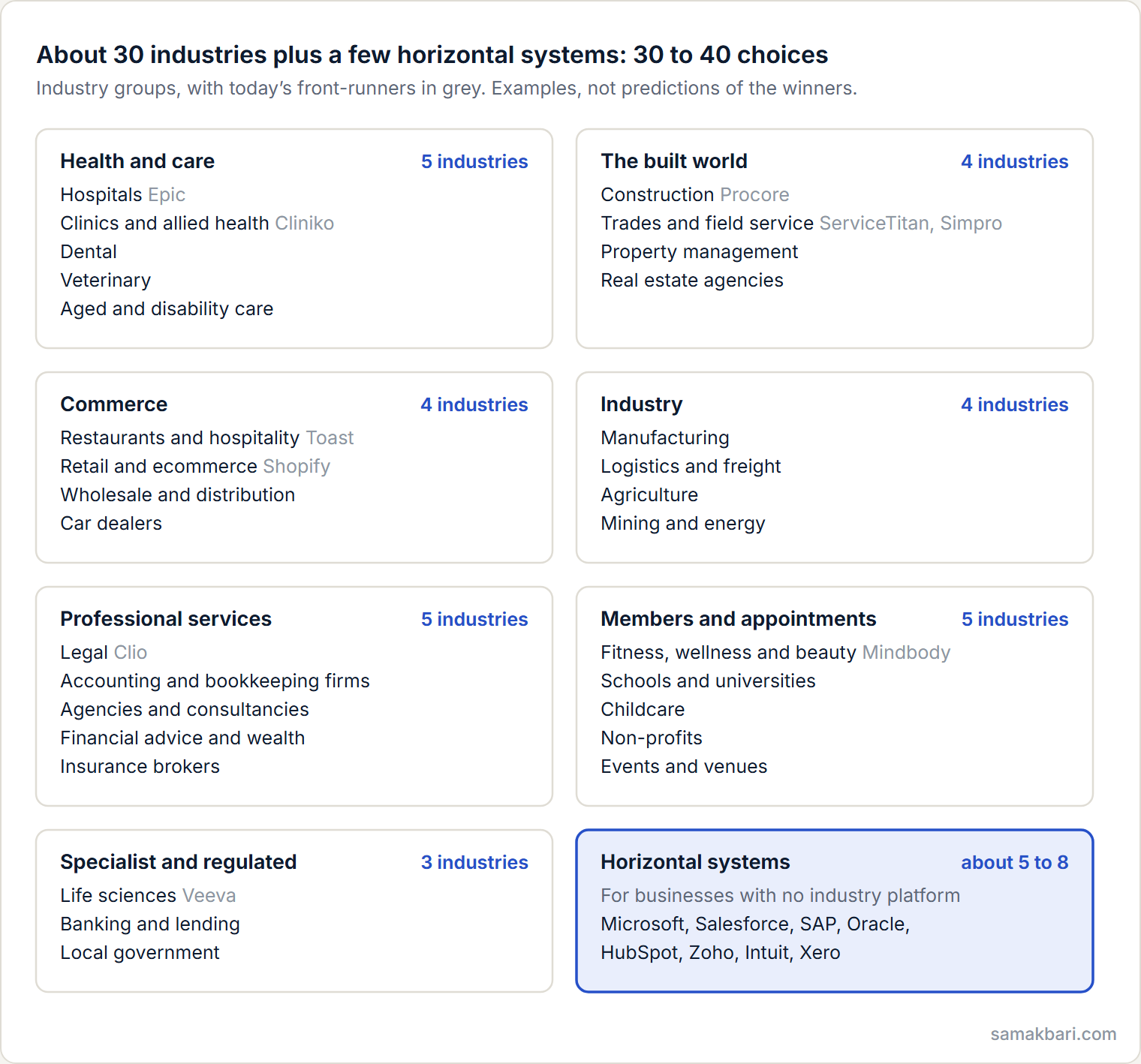
An operating system forms around a core record, and there are only so many distinct ones. So I counted. An industry gets its own operating system when it passes three tests at once:
- A distinct core record. A construction project, a service call and a patient file are different enough that one product rarely serves two of them well.
- Distinct regulation. Health privacy, building codes, legal trust accounting and food safety each force the software to be built differently.
- A distinct money flow. Payments, payroll, claims, deposits or lending that the platform can earn on.
A dental practice and a veterinary clinic both book appointments, but their records, regulators and payers differ on all three tests, so they count separately. Agencies and consultancies share enough that they count once. Applied across the economy, the tests give about 30 industries. Add five to eight horizontal systems for businesses that have no industry platform, and the total is 30 to 40 real choices. Each industry will support one to three of them, the way phones settled on two.
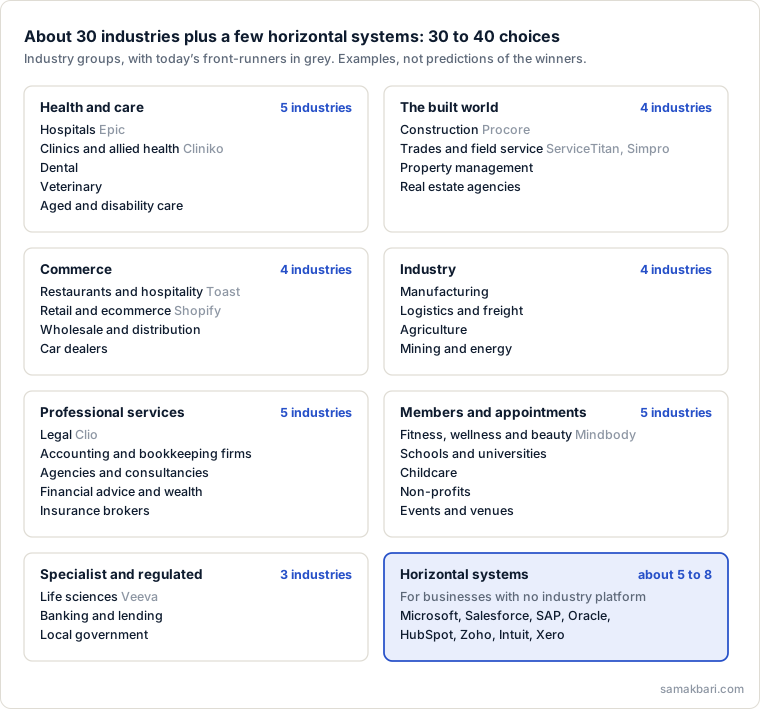
The names on the map are today’s front-runners, not my picks for the winners, and in several industries the operating system hasn’t been built yet. That’s the opportunity. The number matters less than what it replaces: today a mid-market business makes dozens of software decisions. In this model it makes one big one, and the rest are installs.
From the inside
Here is what that choice looks like from the buyer’s side. At a global consumer brand selling in more than 70 markets, I was the business owner of a US$1M+ digital asset management program. It was built on a document and asset management system we would host and run ourselves on cloud infrastructure: the servers, the integrations and the upgrades were ours, for one job, storing and sharing brand assets.
I recommended we stop it. The alternative was a purpose-built SaaS product that did that one job well, with nothing for us to host or maintain. After due diligence the business switched, which avoided more than US$1M of capital expenditure and about US$600,000 a year in operating cost (the case study).
The lesson is the one in this thesis. A business shouldn’t build and run a platform for a job that isn’t its core record. It should own one centre, and install the best app for everything else.
Three letters
To the frontier labs
You have the interface, the intelligence and the users. You don’t have the record or the money, and you have three to five years before the industry platforms lock them up with your models inside. If you want to be the operating system rather than the engine, the moves are specific: a system of record of your own, not only connectors to other people’s; payments and payroll, which is where Toast earns 82% of its revenue; published revenue-share terms so developers know what building on you is worth; and a position on the conflict, because every industry platform is your customer today and will read your next product launch as a declaration. The engine is a fine business. Intel was a fine business. But Intel never owned the customer, and it’s worth asking now which one you’re building.
To the software incumbents
The market has told you what it thinks you are. Eight of the eleven application companies in the chart above are still more than 10% below their January value, and the ones that recovered did it with buybacks, takeover talk or a lab partnership. There are two ways out and no third. One is to become the operating system of an industry: own its core record, its money flow and its marketplace, and let others build on you, as Toast, Shopify and Rippling have. The other is to become the best app in two or three operating systems, priced and built for their marketplaces, and give up the claim to be the centre. The dangerous place is the middle, a “platform” in a category with fifty others. Atlassian’s recovery this year is the exception that proves it: a product developers run their work on, with a marketplace around it. If you’re adding an AI assistant to a product that holds none of the five parts, you’re decorating an app.
To governments
Three things arrive with forty operating systems, and all three are familiar.
The app-store problem, again. When platforms consolidate they set the terms: the phone app stores’ standard 30% commission, control of in-app payment, and a decade of disputes with developers and regulators. The ACCC’s final Digital Platform Services Inquiry report in 2025 found that app marketplaces “remain crucial services” and “a critical gateway for generative AI innovation to reach consumers”, and the Australian Government intends to prioritise them for designation under its proposed digital competition regime. The EU’s Digital Markets Act already imposes app distribution, interoperability and data portability duties on gatekeepers. Those rules were written for phones. The same questions, who sets the fees, who controls payment, whether a business can take its data and leave, will be asked of business operating systems before 2030, and it’s cheaper to write the answer now than to litigate it later.
Sovereignty. If a frontier lab becomes the operating system of business, an American company holds the core record of every Australian and European business: every customer, invoice, roster and patient. That’s a different question from where the data is stored. It’s who can change the terms. A government that wants a say should decide now what data portability, local hosting and audit access it requires of any platform that holds a sector’s records, and should make its own procurement, which is itself an industry on the map, follow those rules first.
Systemic risk. Platforms fail all at once. One faulty CrowdStrike update in July 2024 took down 8.5 million Windows machines in a morning, and with them airlines, hospitals and banks. Forty operating systems running every business in the economy are critical infrastructure in the way banks are, and deserve the same expectations of resilience, incident reporting and recovery.
The fourth thing is the opportunity. The industry operating system for aged care, for local government, for agriculture may not have been built yet. A country that builds one exports it.
Where this could be wrong
A thesis worth publishing should say how it fails. The four strongest objections, and my answers.
“Agents will connect everything, so fragmentation stops hurting.” Connection isn’t coherence. An agent that can reach thirty systems still has to decide which one holds the truth, and someone still has to answer when it gets that wrong. Cheaper connections reduce the integration tax. They don’t remove the need for one record.
“The AI layer itself hasn’t consolidated.” True. In May 2026 ChatGPT had 46.4% of AI assistant users, Gemini 27.7% and Claude 10.3%, and enterprise spending on models has swung between labs within a year. A lab that can’t hold its own market will struggle to hold everyone else’s. That’s an argument for future two, not against the thesis.
“Platform consolidation increases the number of apps, so business software will fragment further.” It will, on top. The claim isn’t that business applications get bigger. It’s that a new platform layer, the industry operating system, forms underneath them, and the applications multiply on top of it as they did on Windows and iOS. Dominant platforms also erode and get regulated: IBM’s unbundling and the Microsoft case both came from antitrust action, and Windows’ share of desktops is now 77%.
“Why forty?” It’s a count with a method, not a law. It could settle at 25 or 60. The claim that matters is that each industry consolidates to one to three operating systems. If future one arrives, the number is closer to three.
Six predictions to hold me to
I’d rather be checkably wrong than vaguely right. Each November I’ll score these on this page: met, not met, or too early.
Scored every November, from November 2027. Not yet scored.
| By | Prediction | How we’ll know |
|---|---|---|
| End of 2027 | At least one frontier lab launches payments, payroll or lending for businesses, or buys an industry platform | Announcement by OpenAI, Anthropic or Google |
| End of 2028 | At least three more industry platforms follow Toast and earn more from financial products than from software subscriptions | Their annual reports |
| End of 2028 | Single-function SaaS companies with no platform trade at clearly lower revenue multiples than platforms, and private equity rolls them up as apps for operating systems | Public software valuations and deal announcements |
| End of 2030 | Most new software bought by small and mid-sized businesses is installed from inside a platform’s marketplace, not bought standalone | Vendor disclosures and SMB software surveys |
| End of 2030 | In at least ten industries, one platform holds the core record for more than half of mid-market businesses | Market share data by industry |
| End of 2032 | A mid-market software tender asks for an operating system and lists the apps it must support, rather than tendering each function separately | Tender documents and buyer guides |
If none of these has happened by 2030, the thesis is wrong, and I’ll say so here.
What to do
If you run a business, treat your next platform decision as the big one, and every other software purchase as an install. Name the record your business runs on. Choose the system that holds it on five tests: fit with your industry’s record, depth of its marketplace, its plan for AI agents (where they run, what they can touch, how they’re audited), whether you can take your data out, and how it handles money. Before you sign for another tool that calls itself a platform, ask whether it runs inside the one you’ve got.
If you build software, decide which of two businesses you’re in. Only build an operating system if you can own an industry’s core record and its money flow. Otherwise, be the best app in two or three operating systems.
If you invest or sit on a board, ask where each software company sits. Value gathers in the operating systems, the payments that run through them and the few apps that become the default in several of them. Single-function products that call themselves platforms are the risk in the portfolio, and the roll-up opportunity.
The SaaS era asked every business to choose fifty times and connect the results. The next era asks it to choose once.
Appendix A: every era consolidated its platform
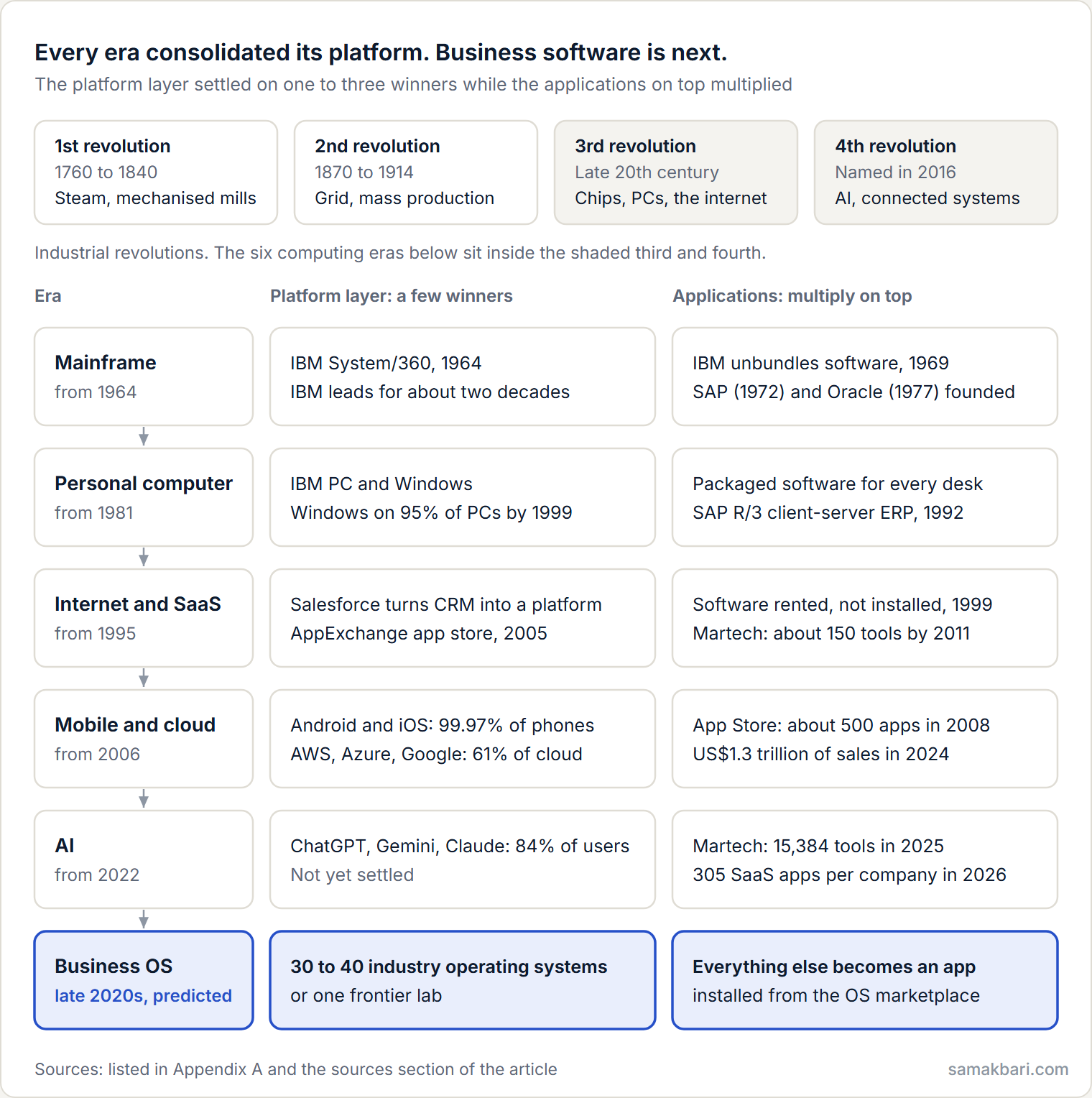
Every era of computing has followed the same pattern. The platform layer consolidated to one to three winners while the applications on top multiplied. Business software is the one big layer that never consolidated.
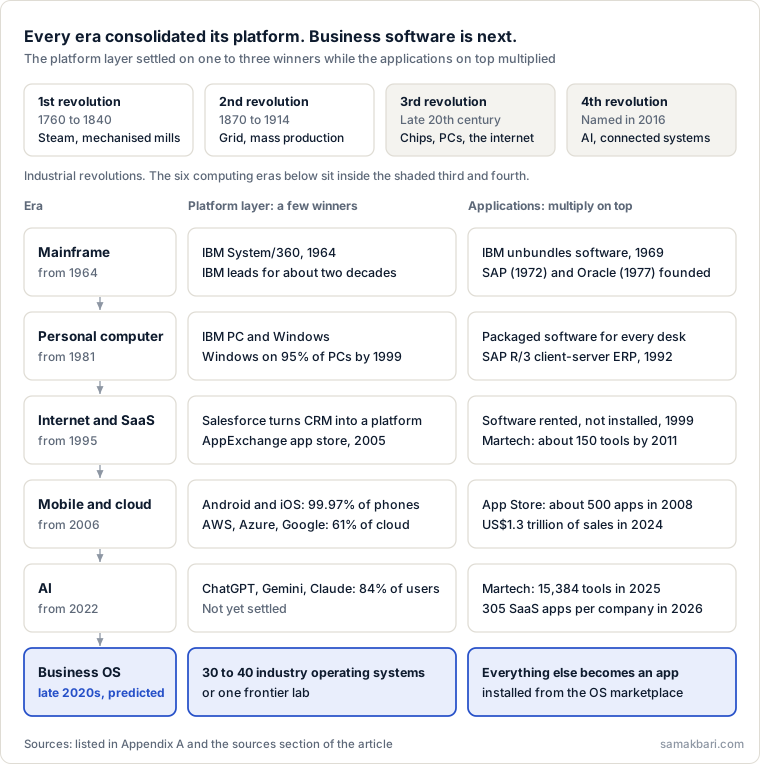
The industrial revolutions set the frame. Steam mechanised production from about 1760, electricity and mass production followed from about 1870, and electronics and computing drove a third revolution in the late twentieth century. In 2016 the World Economic Forum made the “Fourth Industrial Revolution”, with AI at its centre, its Davos theme. Each created a shared platform, first factories, then the grid, then the chip, that a mass of products was built on.
Chips. Bell Labs demonstrated the transistor in December 1947. The integrated circuit followed in 1958 and 1959, Gordon Moore’s prediction in 1965 and Intel’s first microprocessor in 1971.
Mainframes. IBM’s System/360 of 1964 replaced five incompatible product lines with one architecture, and IBM led for about two decades. In 1969, under antitrust pressure, IBM began selling software separately. Software became a product; SAP was founded in 1972 and Oracle in 1977.
PCs. The IBM PC of 1981 set the standard and Windows ran on it. By 1999 a US court found Microsoft held at least 95% of operating systems for Intel-compatible PCs. SAP’s client-server R/3 made ERP the system of record for large companies from 1992.
Internet and SaaS. Netscape’s 1995 listing opened the web era. Salesforce launched in 1999 against “the end of software” and in 2005 opened AppExchange, the first big app store for business software: a business application that turned itself into a platform.
Mobile and cloud. Amazon launched S3 and EC2 in 2006. Apple announced the iPhone in 2007 and opened the App Store with about 500 apps in 2008; Apple says its ecosystem facilitated US$1.3 trillion of sales in 2024. In 2011 Marc Andreessen wrote that software is eating the world. It did, one app at a time.
AI. ChatGPT launched on 30 November 2022 and reached 900 million weekly users by February 2026.
Appendix B: the market in detail
Concentration by layer. Wherever a true platform exists, two or three players hold most of it. In business applications, even the leaders hold single digits.
| Market | Leaders | Combined share | Period | Source |
|---|---|---|---|---|
| Mobile operating systems | Android 72.4%, iOS 27.6% | 99.97% | October 2026 | StatCounter |
| Enterprise spend on AI model APIs | Anthropic 55%, OpenAI 31%, Google 9% | 95% | 2026 | Menlo Ventures (an Anthropic investor) |
| Cloud infrastructure | Amazon 26%, Microsoft 19%, Google 16% | 61% | Q3 2026 | Synergy Research |
| CRM software | Salesforce 20.0%, then four vendors at 3 to 4% each | about 35% for the top five | 2025 | IDC, via Salesforce; the runners-up are from secondary reports of the IDC tracker |
| ERP software | Oracle 6.7%, SAP 6.6%, Intuit 4.5%, Constellation 4.0%, Microsoft 2.2% | 31.9% for the top ten | 2025 | Apps Run The World |
The sell-off, measured. Software ETF (IGV) peak 22 September 2025; 12 January to 23 February 2026, down 27%; low 10 April 2026, down 37% from the peak; 3 November 2026, still 13% below the peak. An equal-weighted software index (XSW) is back above its 2025 peak, so the typical smaller company has recovered while the large incumbents have not. The semiconductor ETF (SMH) dipped 7% over the same weeks and is now a third above its January level. All from Yahoo Finance daily closes, split-adjusted.
Value lost. My ten-company basket (Salesforce, Adobe, ServiceNow, Workday, Atlassian, HubSpot, Intuit, SAP, Shopify, Toast): US$1,356 billion on 9 January, US$941 billion on 23 February, US$837 billion on 10 April, US$1,060 billion on 3 November 2026. Published sector-wide estimates: about US$1 trillion in a week (Bloomberg, Reuters) and US$2 trillion (Fortune, citing JPMorgan: software’s weight in the S&P 500 fell from 12.0% to 8.4%).
What drove the recovery. Results: Snowflake and Okta in May, Atlassian’s best day since its 2015 listing in August, Salesforce’s second-best day ever on 27 August. Lab partnerships: Anthropic’s 24 February integrations and Claudeforce in August. Buybacks: Salesforce’s US$25 billion accelerated repurchase cut its share count by about 12%, so its share price fell less than its market value. Takeover talk: Workday and Silver Lake. Sentiment: Nvidia’s Jensen Huang calling it an “incredible time to be a software company” on 1 June.
The reversals. ServiceNow fell 18% on 23 April and 27% on 29 October, its worst day on record. Intuit fell 20% on 21 May as it announced 17% job cuts. HubSpot fell about 19% on two separate days.
Where the money went. Anthropic raised at a US$965 billion valuation in May 2026, and OpenAI at US$852 billion in March. Either lab alone is worth about as much as the ten application companies together.
Appendix C: the ERP failures
| Organisation | System | Budget | Outcome | Source |
|---|---|---|---|---|
| Queensland Health | SAP payroll, IBM prime contractor, 2007 | A$6.19 million | KPMG forecast A$1.25 billion to 2017, after 2,500 customisations and more than 130 manual workarounds | iTnews, 7 June 2012 |
| Lidl | SAP merchandise system (eLWIS), 2011 to 2018 | €201 million originally | Stopped in July 2018 after about €500 million (press estimate); Lidl’s stock valuation method didn’t match the software’s | Consultancy.uk, 13 August 2018 |
| Birmingham City Council | Oracle Fusion finance and HR, planned go-live 2020 | £19 million | Forecast £144.4 million to 2027/28; still incomplete five years after the planned go-live; a factor in the council’s 2023 effective bankruptcy | The Register, 29 January 2026 |
Not all of this is the vendors’ fault; customers, integrators and scope all play a part. The pattern is the point. SAP’s mainstream maintenance for its older ECC system ends in 2027, with extended maintenance to 2030, which forces the next round of migrations.
Changelog
- v1.0, November 2026. First published. Market data to 3 November 2026; the charts use month-end closes to October 2026.
Sources
All pages opened on 4 November 2026 unless dated.
Markets and companies
- Yahoo Finance daily and month-end closes for IGV, SMH, XSW and company shares, split-adjusted, cross-checked with stockanalysis.com; market values from companiesmarketcap.com
- Reuters via Yahoo Finance, Anthropic’s AI tools deepen sell-off, 4 February 2026; Fortune, Trillion-dollar tech wipeout, 5 February 2026, and US$2 trillion software wipeout, 10 February 2026
- CNBC: best month since 2001, 29 May 2026; Intuit job cuts, 20 May 2026; Workday and Silver Lake, 13 August 2026; Salesforce results, 27 August 2026; ServiceNow results, 29 October 2026
- Salesforce, Form 8-K on its accelerated share repurchase, March 2026; Salesforce and Anthropic, Claudeforce announcement, 27 August 2026
- Toast, Form 10-K for 2025; Shopify, A world with more builders, 28 July 2026; Klaviyo, Form S-1, August 2023; Intuit, FY2023 financial report; Rippling, Garry Tan’s interview with Parker Conrad
- Market share: StatCounter mobile and desktop, October 2026; Synergy Research, Q3 2026 cloud market, 29 October 2026; Menlo Ventures, 2026: the state of enterprise AI, 3 November 2026; Salesforce on the IDC CRM ranking, June 2026; Apps Run The World on ERP vendors
- Anthropic, Series H, 28 May 2026; Yahoo Finance, OpenAI closes US$122 billion funding, 1 April 2026
The labs
- OpenAI, Introducing apps in ChatGPT, 6 October 2025; Axios, OpenAI launches platform to manage AI agents, 5 February 2026; OpenAI, OpenAI launches the Deployment Company, 11 May 2026
- Anthropic, Cowork plugins across the enterprise; Fortune, Anthropic’s services joint venture, 4 May 2026
- Yahoo Finance, Google launches Gemini Enterprise, October 2025
- CX Today on Satya Nadella’s BG2 interview, Microsoft CEO: AI agents will transform SaaS as we know it, 23 December 2024 (the episode itself was released on 12 December 2024)
- TechCrunch, ChatGPT reaches 900M weekly active users, 27 February 2026, and ChatGPT’s market share slips below 50%, 16 June 2026
Fragmentation, ERP and history
- MarTech, The number of martech tools is now 15,384, May 2025; Zylo, The great rationalization is here, 2026
- iTnews, QLD Health payroll bungle to cost $1.25 billion, 7 June 2012; Consultancy.uk, Lidl cancels SAP introduction, 13 August 2018; The Register, Birmingham’s Oracle ERP now £144M, 29 January 2026, and Don’t expect another SAP support extension, 13 December 2022
- Computer History Museum, the point-contact transistor and IBM unbundles software; IBM, System/360 and the IBM PC; US Department of Justice, US v. Microsoft findings of fact, 5 November 1999; Salesforce, The history of Salesforce; AWS, Announcing Amazon S3, 13 March 2006; Apple, iPhone 3G on sale tomorrow, 10 July 2008, and the global App Store ecosystem, June 2025; Marc Andreessen, Why software is eating the world, 20 August 2011
Government
- ACCC, Digital Platform Services Inquiry final report, March 2025 (published June 2025)
- European Commission, the Digital Markets Act
- Microsoft, Helping our customers through the CrowdStrike outage, 20 July 2024