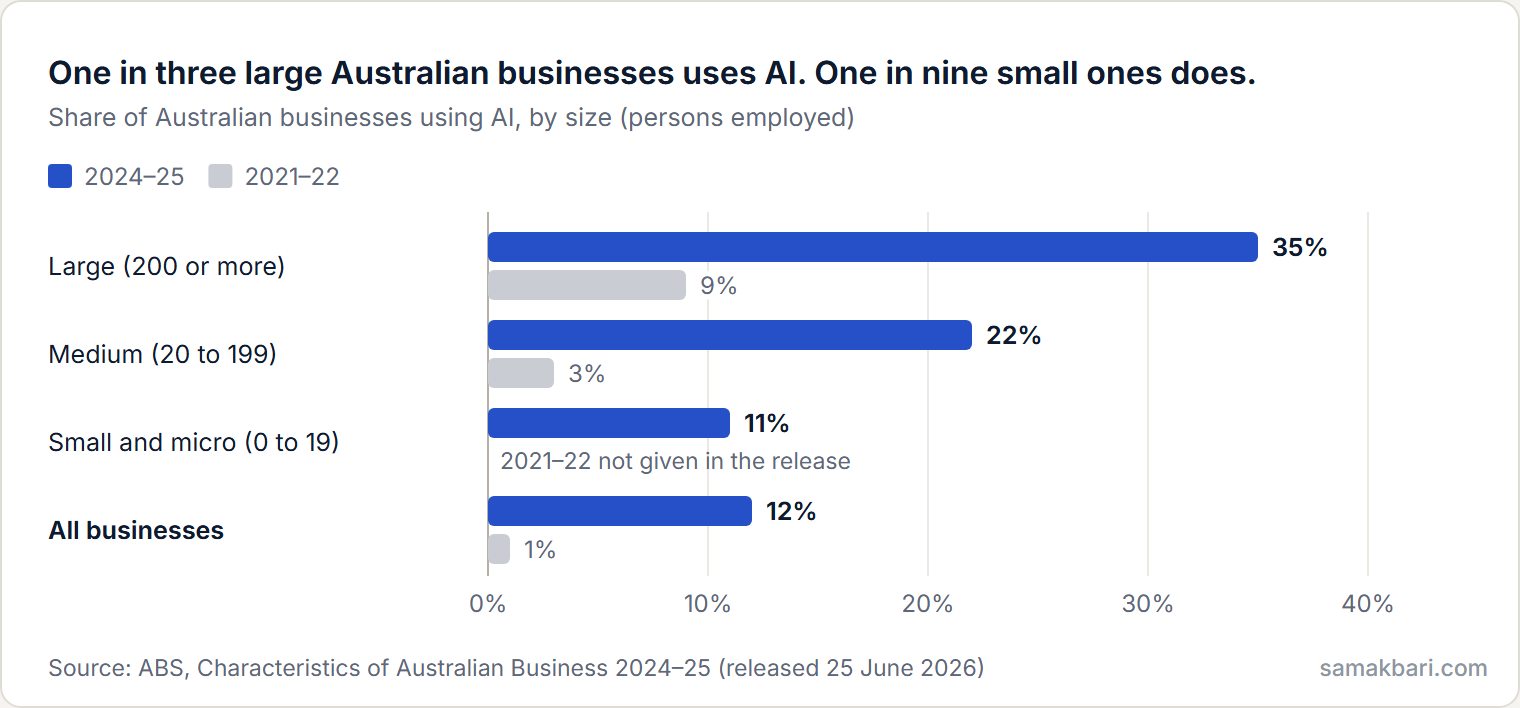

Short answer: about 12% of Australian employing businesses used AI in 2024–25, up from 1% three years earlier, but size makes a big difference: around 35% of large businesses (200 or more people) used it, 22% of medium businesses and about 11% of small and micro ones (ABS, June 2026). The National AI Centre’s monthly survey puts small and medium business use at 43%, because it counts any level of use. Neither number tells you whether AI is paying off.
I get asked some version of “are we behind on AI?” by most CEOs I speak to. Often a vendor pitch has just claimed that everyone else already has. The official numbers tell a more useful story, and it’s mostly a story about company size.
This piece pulls together the three Australian sources worth knowing, the ABS, the National AI Centre and the AICD, and explains why they disagree. Then it says what the numbers mean for a company of 50 to 500 people.
How many Australian businesses use AI? The latest figures
The most reliable figure, published in 2026, is the ABS Characteristics of Australian Business, 2024–25, released on 25 June 2026. It surveyed about 7,000 employing businesses between October 2025 and February 2026, with an 87.9% response rate (ABS methodology). Its answer: 12% of businesses reported using AI in 2024–25, against 1% in 2021–22, before tools like ChatGPT were available.
That’s the latest official number. The ABS has said it will ask more about AI in the 2026–27 survey, so the next detailed picture is some way off.
How does AI adoption change with company size?
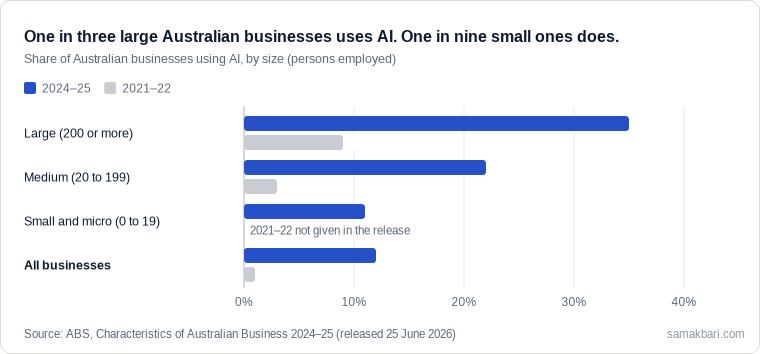
This is where the national average misleads. Adoption climbs steeply with size:
| Business size (persons employed) | Using AI, 2024–25 | Using AI, 2021–22 |
|---|---|---|
| Large (200 or more) | about 35% | 9% |
| Medium (20 to 199) | 22% | 3% |
| Small and micro (0 to 19) | about 11% | not published |
| All employing businesses | 12% | 1% |
Source: ABS media release, 25 June 2026.
The national 12% is close to the small business figure because most Australian businesses are small. If you run a company of 50 to 500 people, the medium and large rows are the ones that describe your competitors.
Europe shows the same pattern. Across the EU in 2025, 17% of small enterprises (10 to 49 employees), 30% of medium ones and 55% of large ones (250 or more) used AI (Eurostat). The size bands and survey questions differ from the ABS, so don’t read the countries against each other line by line. The point is that the gap with size isn’t an Australian quirk.
Is it size, or how the business is run?
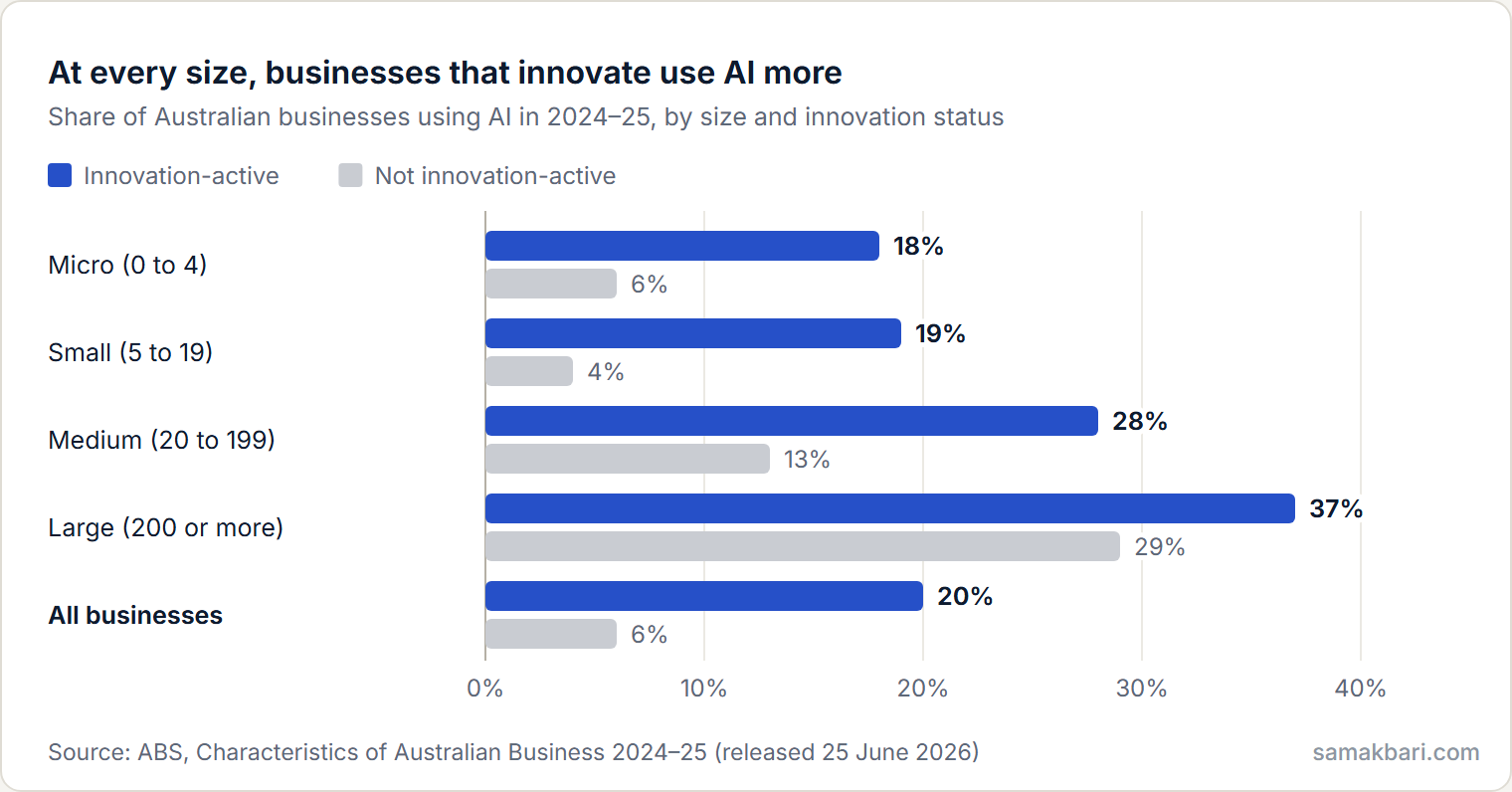
The ABS split its figures by whether a business was “innovation-active”, broadly, one that introduced or was working on a new or improved product, process or way of doing things during the year. That turns out to matter more than headcount:
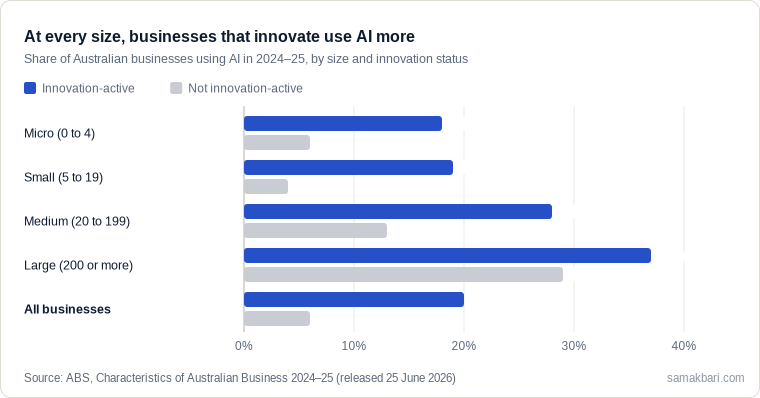
A small business that innovates (19%) is more likely to use AI than a medium business that doesn’t (13%), and almost five times as likely as a small business that doesn’t (4%). Across all sizes, 20% of innovation-active businesses use AI against 6% of the rest (ABS).
In practice, AI shows up in companies that already have someone whose job is to change how work gets done. It rarely arrives on its own in a business that’s running flat out on last year’s processes.
Which industries use AI the most?
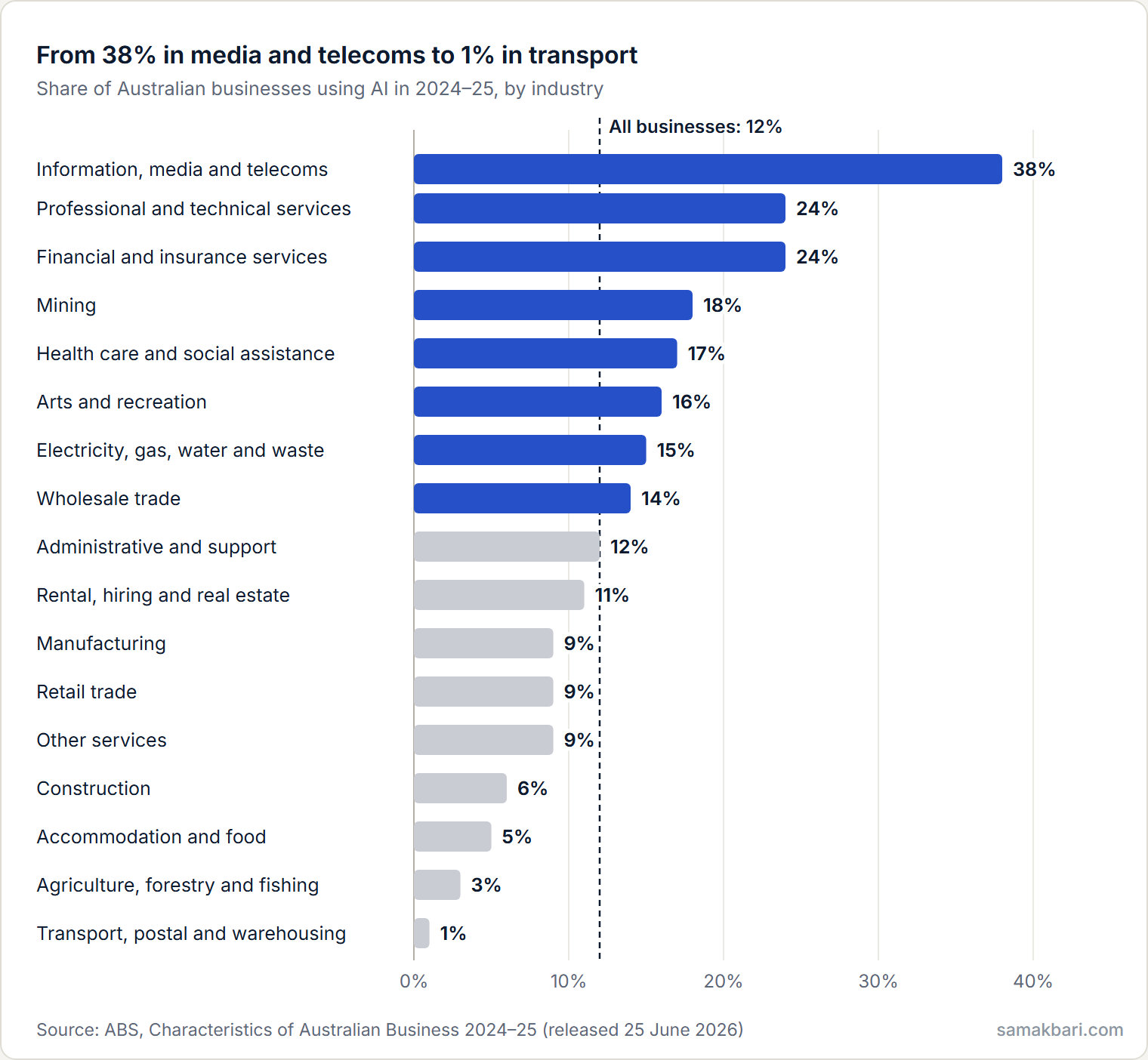
Industry matters as much as size. Information, media and telecommunications is at 38%, three times the national figure. Transport, postal and warehousing is at 1%.
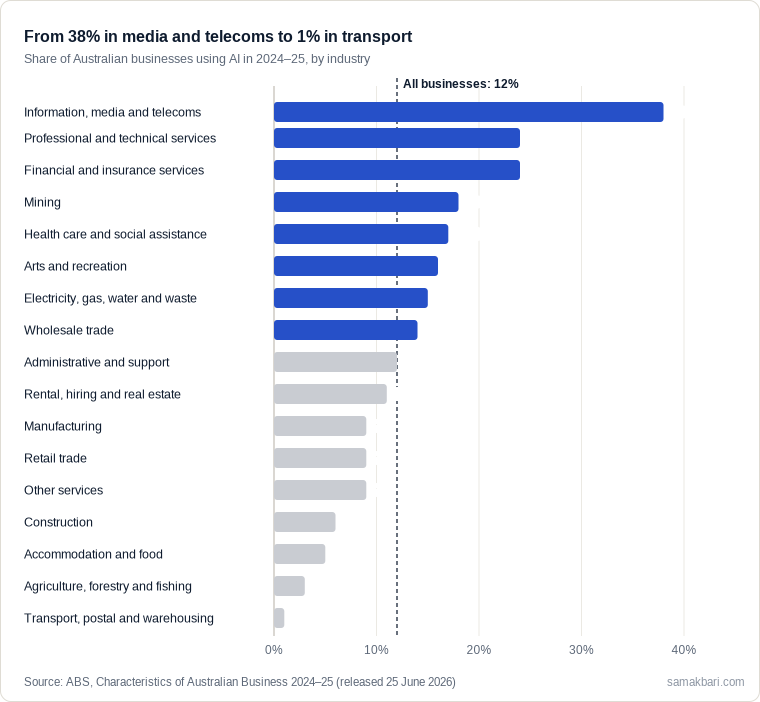
Financial and insurance services climbed furthest relative to where it started: the ABS says its adoption is 24 times the 2021–22 level of 1%. The industries at the bottom are mostly hands-on, physical work, where general-purpose AI tools have the least obvious use.
Why do the surveys disagree: 12% or 43%?
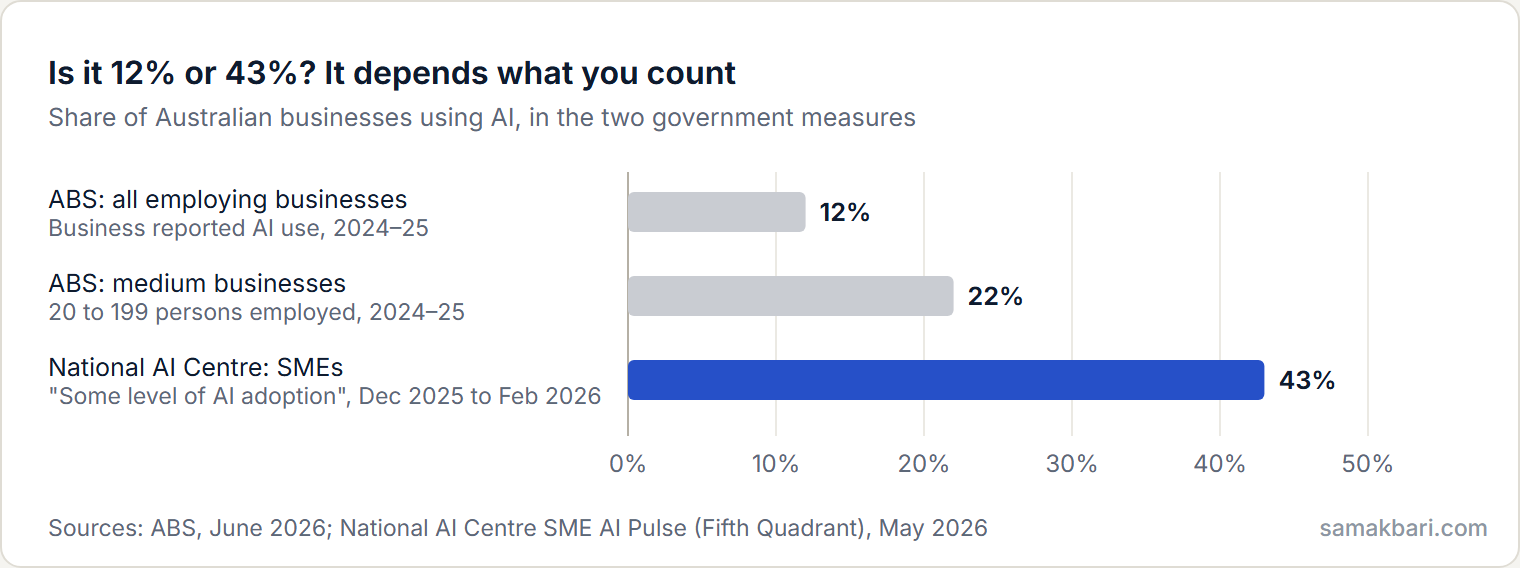
If you’ve seen a much higher number quoted, it’s probably the National AI Centre’s SME AI Pulse, a monthly survey of at least 400 small and medium business owners and decision-makers run by Fifth Quadrant. From December 2025 to February 2026, 43% of SMEs reported “some level of AI adoption”, down slightly from 45% the quarter before; the February figure alone was 44% (National AI Centre, 7 May 2026, updated 3 June).
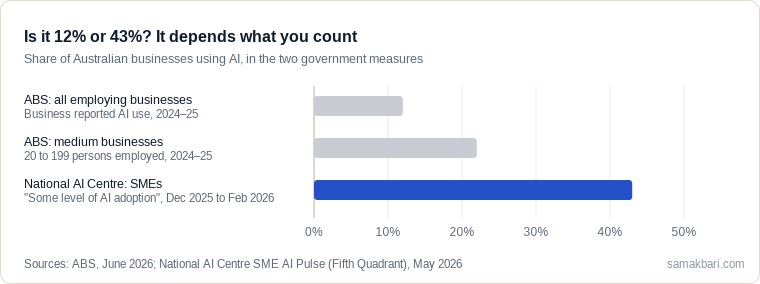
Both are government-backed numbers, and both can be right. They measure different things:
| ABS Characteristics of Australian Business | National AI Centre SME AI Pulse | |
|---|---|---|
| Who answers | The business, in an official statistical survey | An owner or decision-maker |
| Sample | About 7,000 employing businesses, 87.9% response | At least 400 SMEs a month, weighted |
| What counts | The business reported using AI | Any level of adoption, including limited, one-off use |
| Period | 2024–25 financial year | December 2025 to February 2026 |
| Result | 12% (35% of large businesses) | 43% of SMEs |
The gap is partly timing (the ABS year ended in June 2025; the National AI Centre survey ran six to nine months later) and partly the difference between “the business uses AI” and “someone here has tried ChatGPT”. For a CEO, the ABS number is the more conservative and more reliable count of businesses using AI at all, though the ABS notes its question doesn’t measure how much they use it. The National AI Centre’s number is a better guide to how many are trying it.
The National AI Centre’s data is also useful on why businesses hold back. Among SMEs not adopting AI, around 65% pointed to distrust of AI decision-making or a preference to keep people in control, and 54% said AI wasn’t relevant to their business. 19% of SMEs said they simply didn’t know how to use it in their business. Among businesses using or planning to use AI, the most common uses were content generation and data analytics (54% each) and cyber security (48%).
What are boards saying?
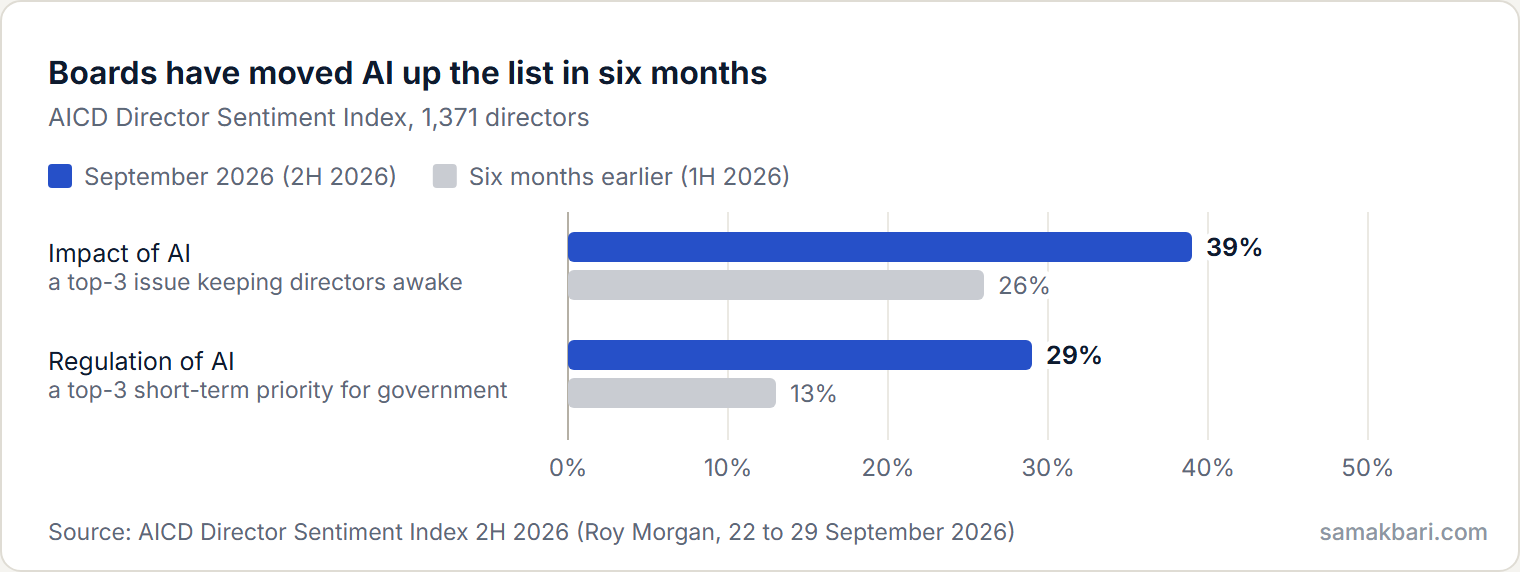
Directors have moved fast. In the AICD’s Director Sentiment Index, a Roy Morgan survey of 1,371 directors from 22 to 29 September 2026, the share naming the impact of AI as a top-three issue keeping them awake at night rose from 26% to 39% in six months. The share wanting the federal government to treat AI regulation as a short-term priority more than doubled, from 13% to 29% (AICD, 11 November 2026).
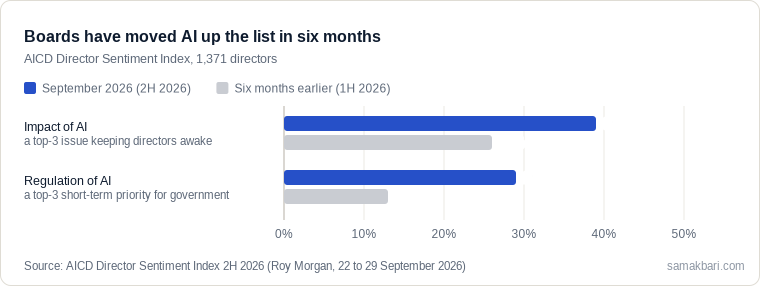
The same survey shows how modest the payoff still is. Only 4% of directors said their organisation doesn’t use AI or AI-enabled automation at all, and 44% reported workforce changes linked to it in the past year, most often redesigned roles (28%). But only 33% said AI had improved productivity to a moderate or great extent; 48% said only to a small extent (AICD insights report, 2H 2026). The directors surveyed are AICD members rather than a sample of all businesses, which is one reason only 4% say their organisation doesn’t use it. The challenge for directors, in the AICD’s words, is shifting from whether to adopt AI to how to turn it into measurable productivity gains.
What do the numbers mean for a mid-market company?
Four things, from where I sit.
- You’re probably not behind yet. In 2024–25, 78% of medium businesses didn’t report using AI. Treat any claim that everyone else has adopted it with caution.
- The gap is widening at the top. Large-business adoption went from 9% to about 35% in three years, and AI has climbed the board agenda in six months. Your larger competitors, and your largest customers, are the ones moving.
- Use isn’t value. Six in ten directors report small or no productivity gains from AI so far. Counting licences or “users” tells you nothing. The test is one process that now costs less, runs faster or loses fewer customers. When I moved a global brand’s translation to an AI-first workflow across 14 languages, the measure was around US$1M a year saved, not how many people logged in.
- Start where you already change things. In the ABS data, AI and innovation go together. Put your first use case inside a process someone already owns and is already improving, not in a side pilot nobody is accountable for. I set out where the return usually is in AI in the mid-market.
And once you’re using it, govern it. Australia’s Guidance for AI Adoption is the government’s view of what responsible use looks like, and the AI governance checklist for boards turns it into questions your directors can ask.
The bottom line
The headline number for Australia is 12%, but the number that matters for you depends on your size and your industry: about one in three large businesses, one in five medium ones, and far more in information, finance and professional services than in construction or transport. Most mid-market companies aren’t behind. They’re about to be, if they treat AI as a tool to try rather than a change to how one process runs.
If you want to see where your business stands, take the free AI Readiness Scorecard. If you’d rather talk it through, book a 30-minute call, or read how I work as a fractional Chief AI Officer.
Common questions
What percentage of Australian businesses use AI?
About 12% of Australian employing businesses reported using AI in 2024–25, up from 1% in 2021–22, according to the ABS Characteristics of Australian Business survey of around 7,000 businesses. The National AI Centre's monthly SME survey puts it higher, with 43% of small and medium businesses reporting some level of AI adoption from December 2025 to February 2026, because it counts any use, including limited one-off use.
Do large businesses use AI more than small ones?
Yes, by a wide margin. The ABS found that around 35% of large businesses (200 or more persons employed) used AI in 2024–25, against 22% of medium businesses (20 to 199) and around 11% of small and micro businesses. In Europe the pattern is the same; Eurostat reports 55% of large enterprises using AI in 2025, against 17% of small ones.
Which Australian industries use AI the most?
Information, media and telecommunications leads at 38% of businesses, followed by professional, scientific and technical services and financial and insurance services at 24% each, according to the ABS for 2024–25. Construction (6%), accommodation and food (5%), agriculture (3%) and transport, postal and warehousing (1%) are the lowest.
Why are small businesses slower to adopt AI?
In the National AI Centre's survey, around 65% of SMEs not adopting AI pointed to distrust of AI decision-making or a preference to keep people in control, 54% said AI wasn't relevant to their business, and 19% of SMEs said they didn't know how to use it. The ABS data adds a fourth factor. Small businesses that innovate use AI almost five times as often as those that don't, which suggests the gap is about how a business runs as well as its size.
Is my mid-market company behind on AI?
Probably not by the national numbers. Most medium businesses (78%) didn't report using AI in 2024–25. But adoption among larger firms is rising fast, and AI has moved up the board agenda, so being typical won't stay a comfortable position for long. A better test than "are we using AI" is whether you can name one process where it already saves money or time.