
Short answer: most Australian companies would never miss a payroll run, yet they routinely pay their contractors late. Large businesses take 55 days to pay 95% of their small business invoices, almost double the typical 29-day term, and nearly a third of invoices aren’t paid within terms at all (Payment Times Reporting Regulator, August 2026). That isn’t a cash problem. It’s a priority problem, and it’s one an executive team can fix.
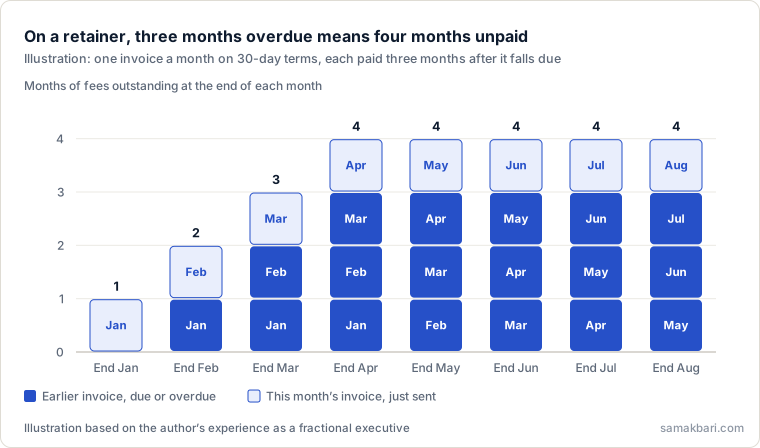
I’ve seen this from two sides of my own work. As a fractional executive, I’ve had monthly invoices fall three to four months overdue, which means doing the next quarter’s work for a client who hasn’t paid for the last one. And at Great Minds, my consulting firm, we have a CRM that sends every invoice and follows it up automatically, and we’ve still had invoices outstanding for months. Better chasing doesn’t fix it, because the problem isn’t on the supplier’s side.
This isn’t only about sole traders. It’s the same for the small consulting firms, agencies and specialist teams that large businesses rely on, with one difference: a small firm has its own payroll to meet while it waits.
Payroll is sacred. Invoices are optional.
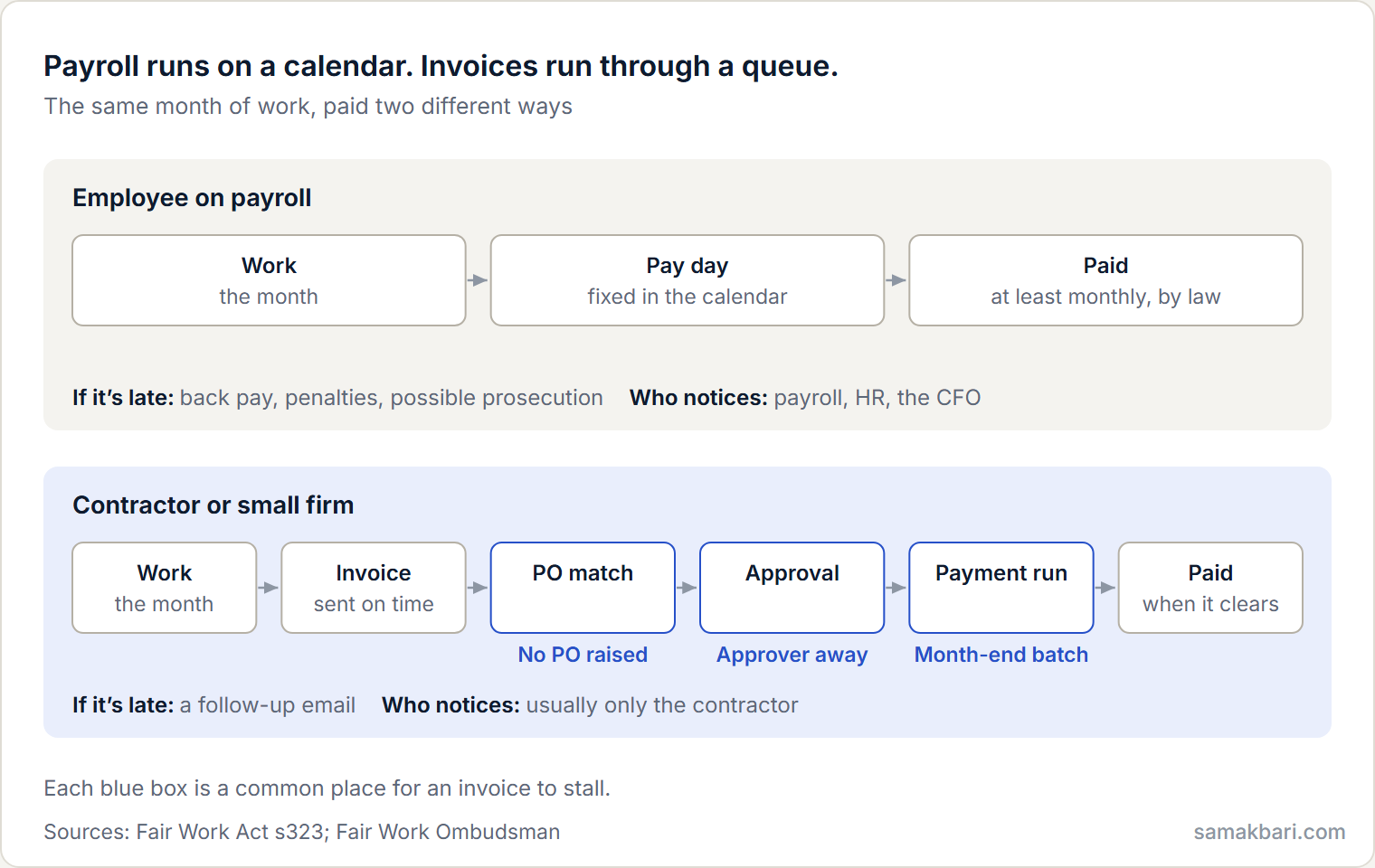
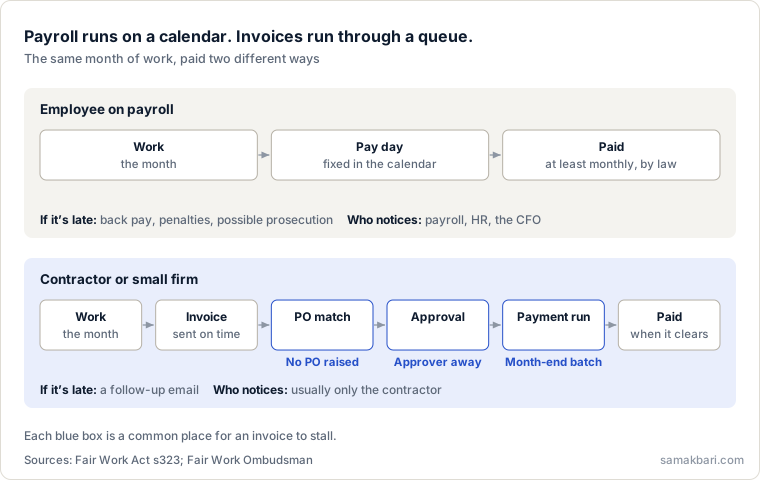
Inside almost every business I’ve worked in, payroll runs on a calendar nobody questions. It’s automated, it’s checked, and if it fails, the CFO hears about it within the hour. Contractor invoices go into a different system: an inbox, an approval queue, a manager who is on leave, a purchase order that was never raised, a month-end batch.
The law reinforces the gap. Employers must pay employees at least monthly under section 323 of the Fair Work Act (Fair Work Ombudsman), and since 1 January 2025 intentionally underpaying an employee can be a criminal offence (Fair Work Ombudsman). Paying a supplier late, on the other hand, is usually just a breach of contract that the supplier has to chase.
So the business protects what it’s forced to protect, and treats everything else as working capital.
What the Australian data shows
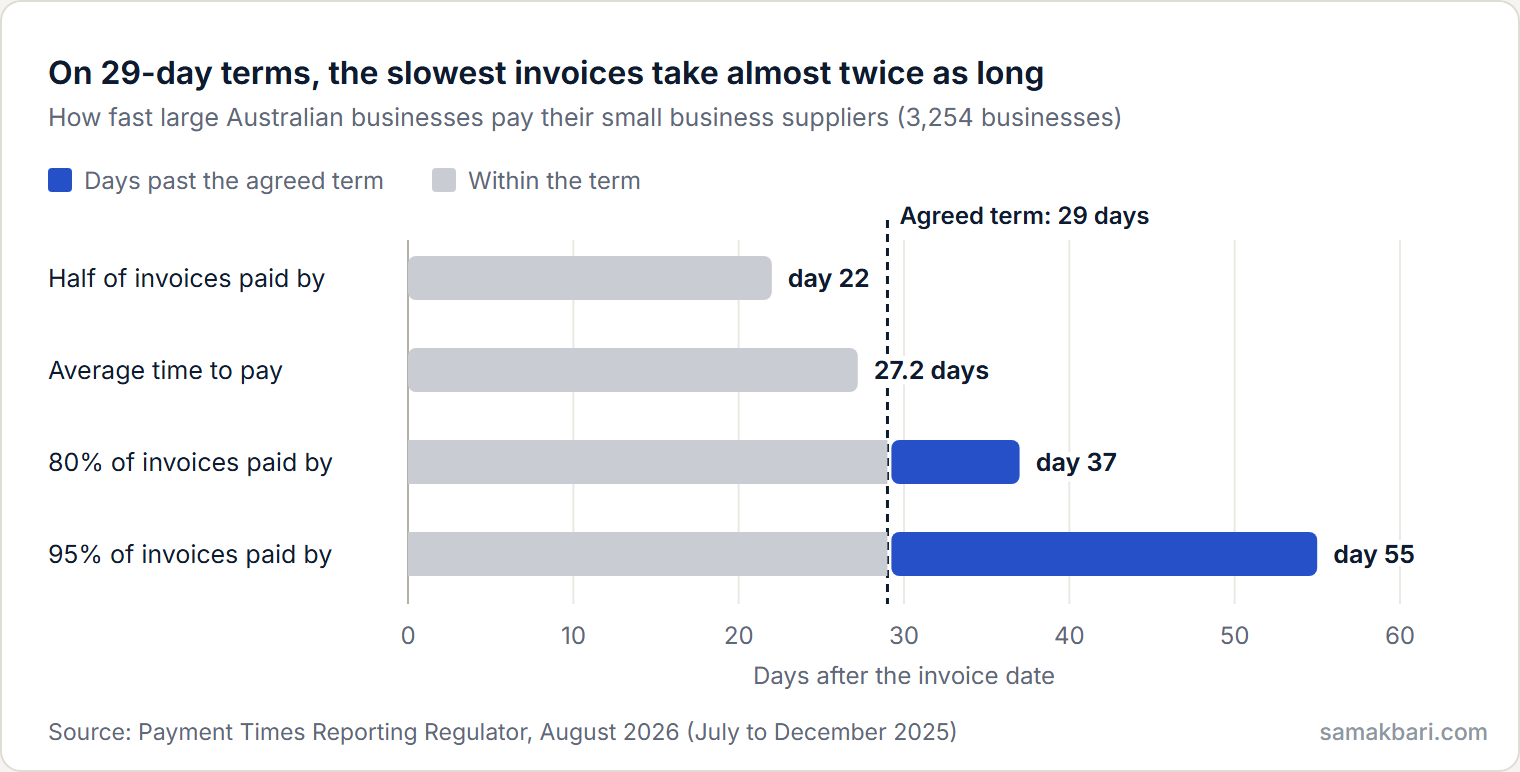
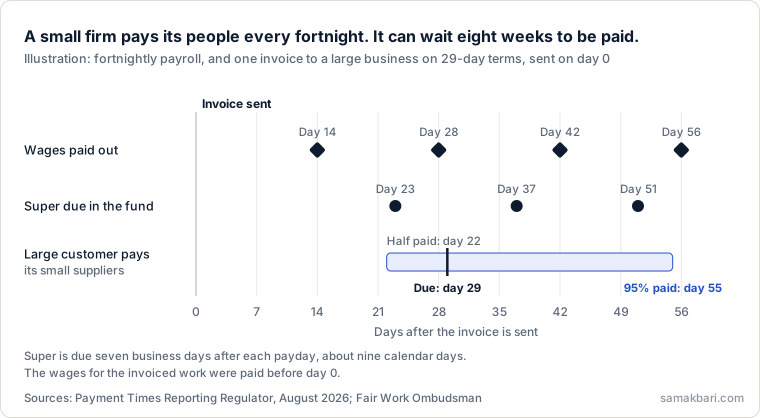
Since 2021, businesses with more than A$100 million in revenue have had to report how fast they pay small business suppliers. The latest results, for July to December 2025, cover 3,254 large businesses. The typical payment term is 29 days and the average payment time is 27.2 days, which looks fine until you look at the tail:
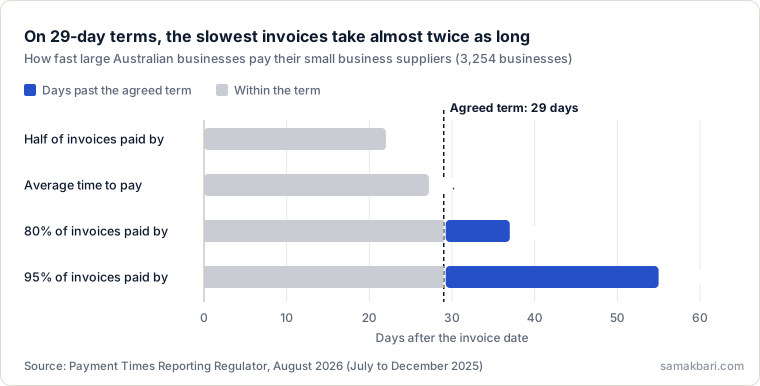
The regulator’s own summary: most small businesses “can expect to wait almost double the agreed payment term”.
- Only 68.5% of invoices are paid within terms. Nearly one in three isn’t.
- 84% of large businesses (2,720 of 3,254) take more than 30 days to pay 95% of their small business invoices. Only 161 pay them within 20 days.
(Payment Times Reporting Regulator, August 2026)
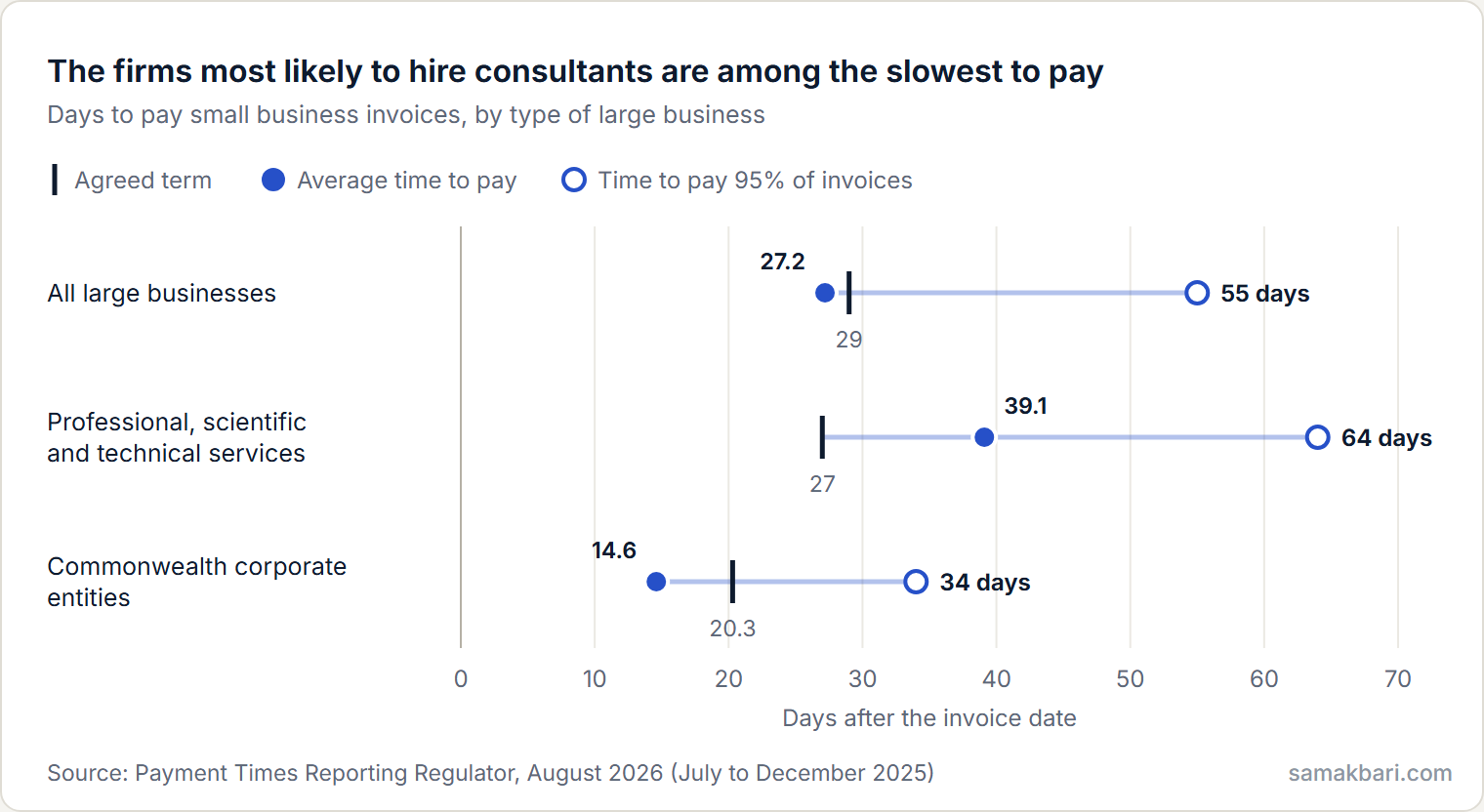
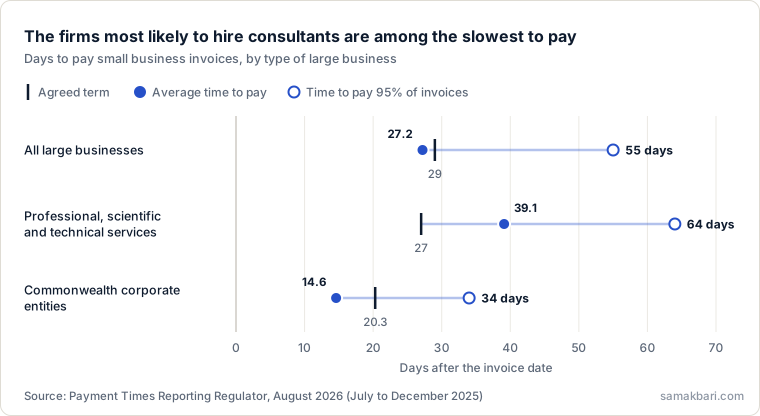
Two industries stand out for anyone who contracts. Large businesses in professional, scientific and technical services, the consultancies, agencies, engineering and IT firms most likely to subcontract specialists, offer terms of 27 days but take an average of 39.1 days to pay and 64 days to pay 95% of invoices. They’re the only industry whose average payment time is well past its own terms. In construction, the industry with the most independent contractors, only 57.4% of small business invoices are paid within 30 days.
And there are a lot of people on the other end of those invoices. Australia had 1.1 million independent contractors in August 2025, 7.6% of everyone employed (ABS, Working arrangements, August 2025). That doesn’t count the small firms that employ people and invoice for their work.
Smaller customers aren’t much better. Xero’s data on Australian small businesses shows invoices paid an average of 6.0 days late in the June 2026 quarter, against a long-run average of about eight days (Xero Small Business Insights). Small businesses told Xero they lost an average of A$15,257 to late payment in the last financial year (Xero, March 2026).
What a late invoice actually costs a contractor or small firm
A late invoice is a rounding error in a large company’s working capital. For a contractor it’s rent, a mortgage repayment or a school fee. For a small consulting firm it’s next fortnight’s wages.
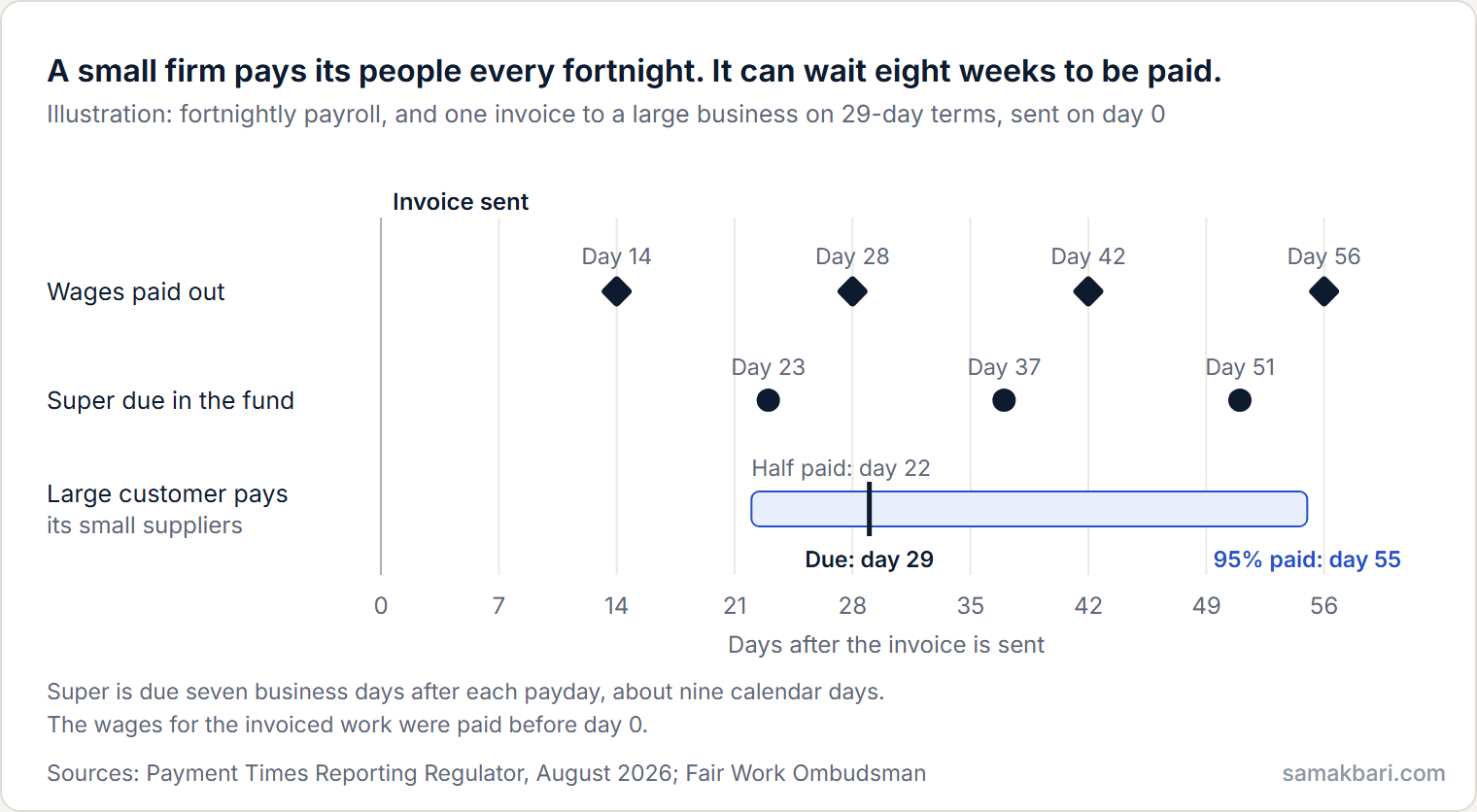
The obligations don’t wait either. A contractor registered for GST who accounts on a non-cash basis owes the ATO the GST for the period in which they issue the invoice, not when they’re paid (ATO). A small firm with staff now has to get their super into the fund within seven business days of each payday under Payday Super, which started on 1 July 2026 (Fair Work Ombudsman). In Xero’s survey, 84% of small business owners said late payments from customers could stop them complying (Xero, March 2026).
So the law now expects the small business to pay its people within days, while its large customers take eight weeks to pay it.
Then there’s the relationship. A contractor who has to chase three invoices in a row stops giving you the benefit of the doubt. They quote higher next time to cover the risk, they move you down their list, and the good ones simply stop taking your work. You’ll never see that in a payment times report, but you’ll feel it when you need someone at short notice.
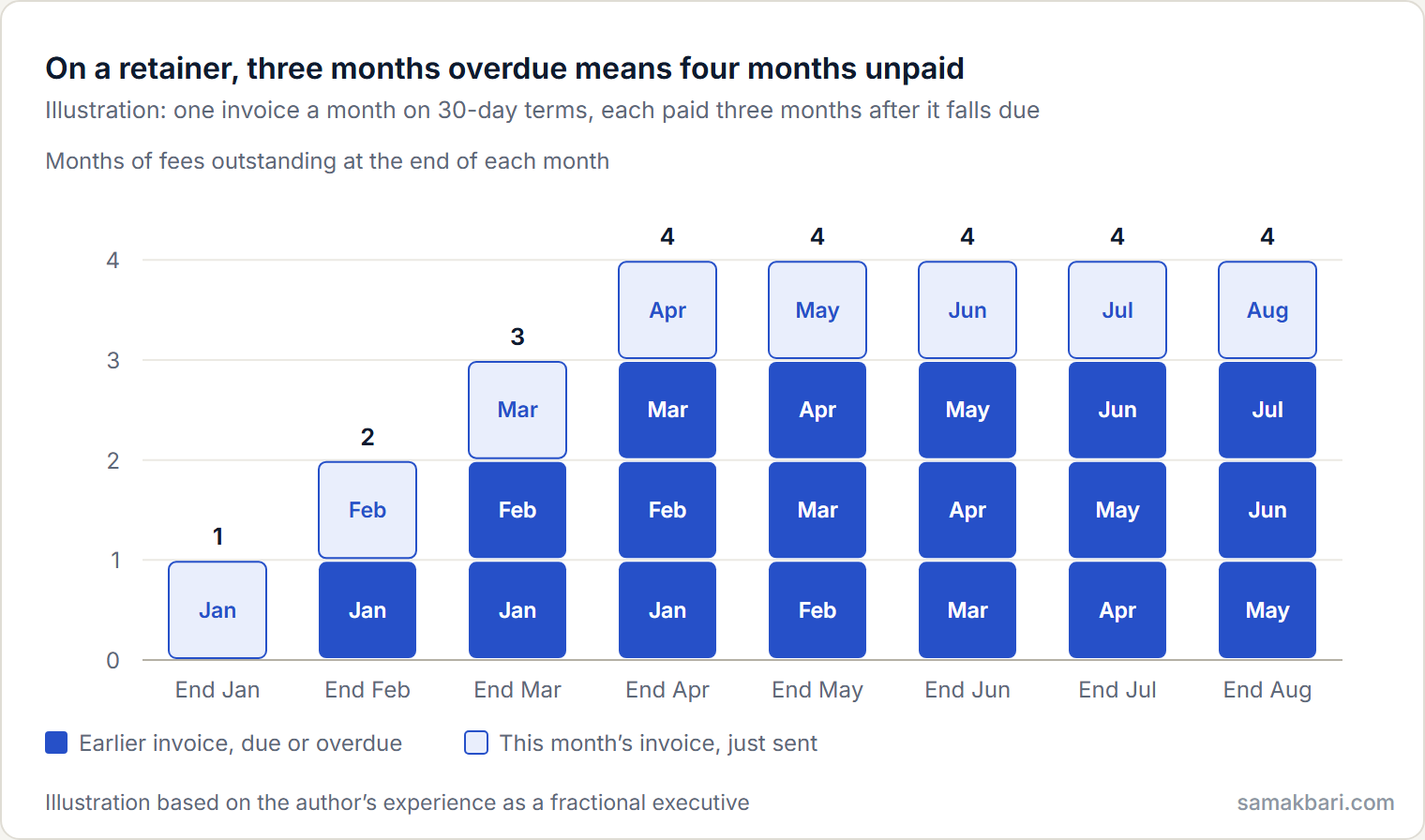
On a monthly retainer, the delay compounds. When an invoice falls three or four months overdue, the next ones have been issued in the meantime, so three or four months of fees are outstanding at once: a quarter of a year’s revenue from that client, sitting in someone else’s approval queue.
Why it happens (it’s rarely the money)
In my experience, very few late payments are a deliberate decision to hold cash. Most come from how the process is built:
- No purchase order. The work started on a handshake, so accounts payable can’t match the invoice and it sits in an exceptions queue.
- One approver. The manager who engaged the contractor is on leave or travelling, and nobody else can approve it.
- Month-end batches. An invoice that arrives on the 2nd waits for a payment run on the 30th, then for terms to run from there.
- Terms written for big suppliers. The standard 45- or 60-day terms the business negotiated with large vendors get applied to a sole trader too.
- Nobody measures it. The exec team sees days payable outstanding as a working capital win, not as a list of people waiting.
Every one of those is an operating problem, and operating problems have owners.
What to change this month (for CEOs and CFOs)
- Put small suppliers on the payroll calendar. Pay approved contractor and small business invoices weekly or fortnightly, in the same rhythm as payroll, rather than in a month-end batch.
- Set shorter terms for small suppliers. Fourteen to 20 days is achievable: Commonwealth corporate entities averaged 14.6 days and paid 80.6% of invoices on time in the second half of 2025 (Payment Times Reporting Regulator).
- Raise the purchase order before the work starts. Then an invoice that matches the order and an approved timesheet can be paid without anyone touching it.
- Give every approver a delegate. No invoice should wait because one person is away.
- Measure the tail, not the average. Report the share paid on time and the time to pay 95% of invoices to the executive team monthly, the way the regulator does. The average will tell you everything is fine.
- If cash is tight, say so before the due date. A contractor can plan around a call. They can’t plan around silence.
None of this is expensive. It’s the same discipline the business already applies to payroll, extended to the people who aren’t on it.
And if you’re the contractor or small firm
Automate your invoicing and reminders, but don’t expect them to do the job alone: ours haven’t. What helps more is agreeing the payment terms in writing before you start, and get the name of someone in accounts payable, not just your manager. Ask for a purchase order number and put it on every invoice. Invoice the day the period ends. And before you sign with a large company, look it up on the Payment Times Reports Register: its 95th percentile payment time tells you how long you’ll really wait.
If you’re running a business where this keeps happening, it’s usually a sign the operating rhythm needs work. That’s the kind of thing I fix as a fractional COO.
Common questions
How long do large Australian businesses take to pay small suppliers?
On average 27.2 days, against a typical payment term of 29 days. But averages hide the tail. It takes 55 days for large businesses to pay 95% of their small business invoices, and nearly a third of invoices (31.5%) aren't paid within the agreed terms, according to the Payment Times Reporting Regulator's data for July to December 2025.
Is it illegal to pay a contractor late in Australia?
Usually it's a breach of contract rather than an offence. That's the difference from payroll. Employers must pay employees at least monthly under the Fair Work Act, and since 1 January 2025 intentionally underpaying an employee can be a crime. Large businesses must report their payment times to small suppliers, but the penalties apply to failing to report, not to paying slowly. Construction has extra protection under each state's security of payment laws.
What are fair payment terms for a contractor?
For a sole trader or small business, 14 to 20 days is fair and achievable. Commonwealth corporate entities averaged 14.6 days in the second half of 2025, and 161 large businesses paid 95% of their small business invoices within 20 days. Whatever the term, the bigger point is to pay within it every time.
How can I check whether a large company pays its suppliers on time?
Search for it on the Payment Times Reports Register (paymenttimes.gov.au). Businesses with more than A$100 million in revenue report their payment terms, average payment time, the time to pay 95% of small business invoices and the share paid on time, every six months.
What should a contractor or small firm do when an invoice is late?
Follow up the day after it falls due, with the accounts payable team as well as your manager, and ask what's holding it up rather than whether it's been paid. Most late invoices are stuck in an approval queue, not refused. If it drags on, a formal letter of demand, the Australian Small Business and Family Enterprise Ombudsman and, in construction, your state's security of payment process are the next steps.