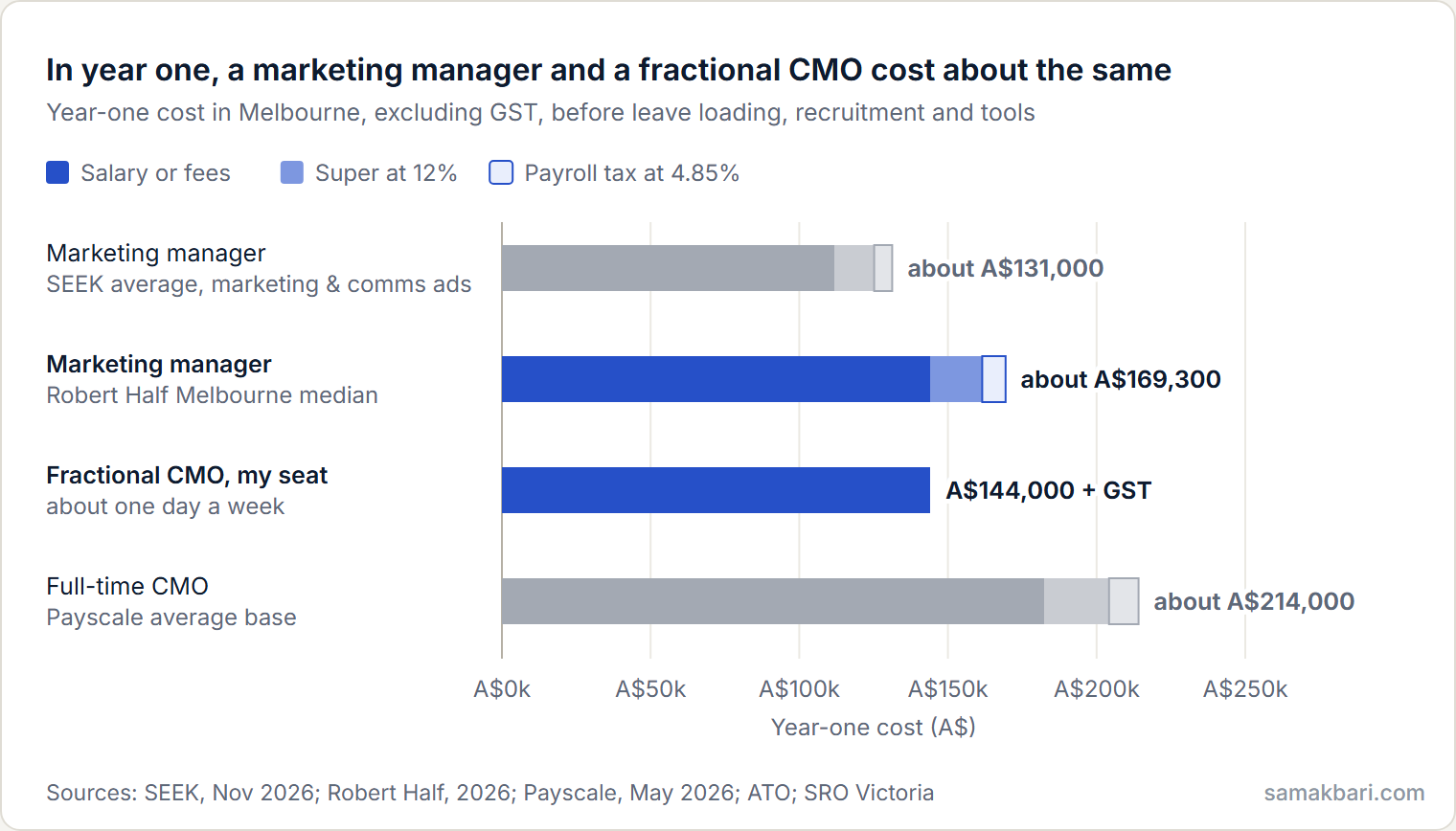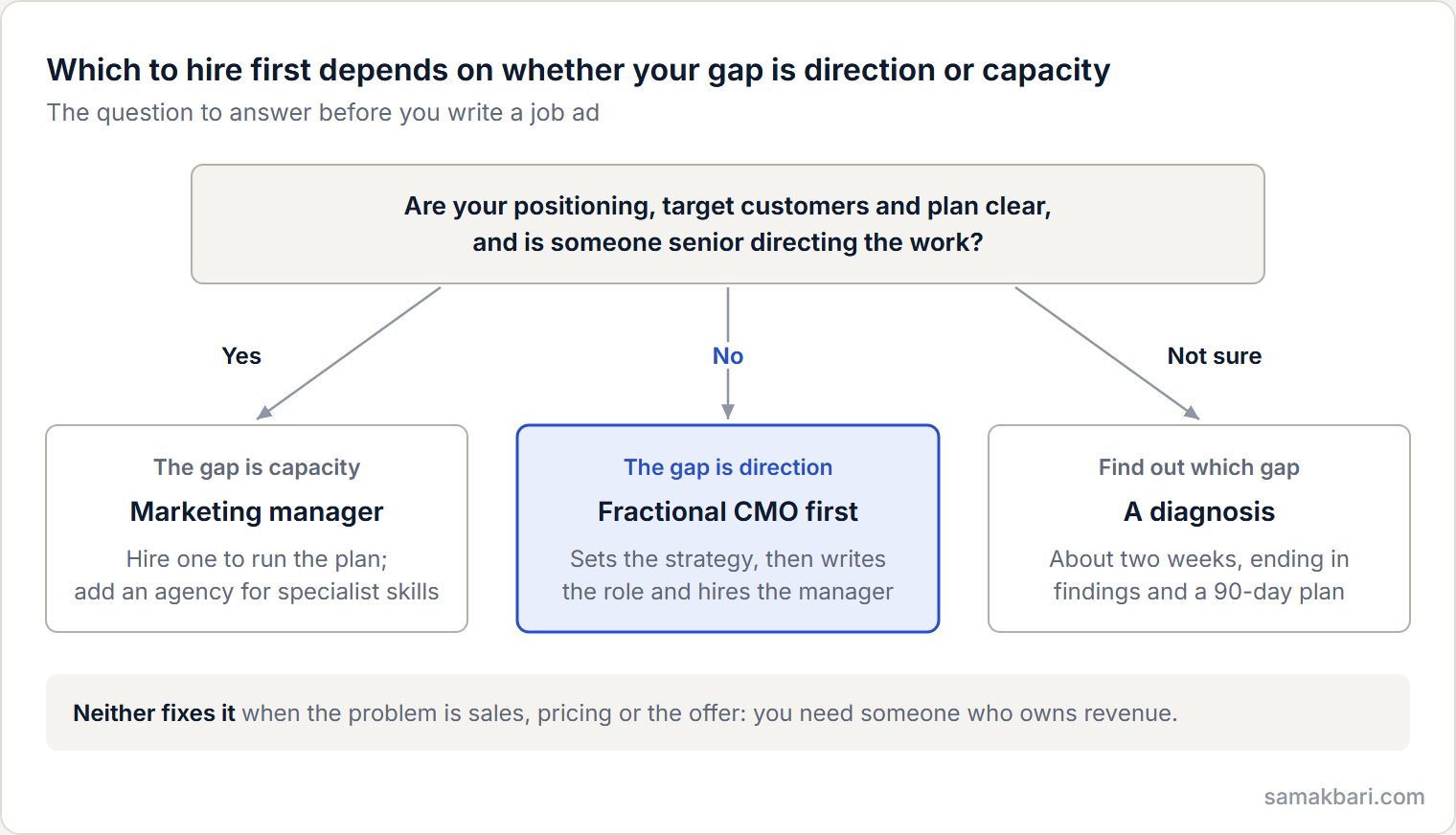
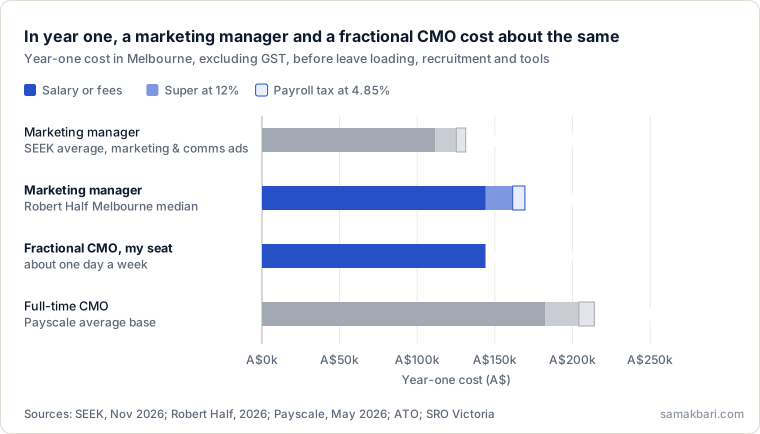
Short answer: hire a full-time marketing manager first when your positioning, target customers and plan are already clear and what’s missing is someone to run the work every day. Bring in a fractional CMO first when nobody senior owns the strategy, because a marketing manager hired into that gap usually ends up guessing. Over a year in Melbourne the two cost about the same: roughly A$169,000 for a marketing manager at the median salary with super and payroll tax, and A$144,000 + GST for my fractional CMO seat at about one day a week. Many mid-market businesses do both, in that order.
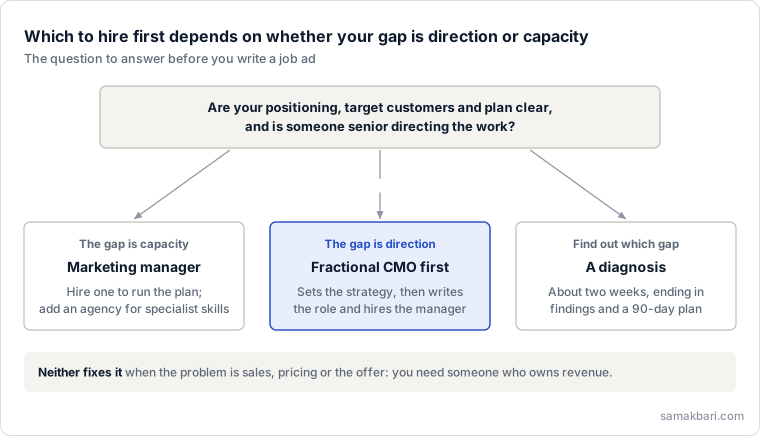
This is one of the questions I hear most from CEOs who have outgrown the founder doing marketing on the side. It usually arrives as “should we get a senior person part-time, or a full-time person who’s actually here?” Both are reasonable. The answer depends on whether your gap is direction or capacity.
I’ve held the senior seat, as Chief Revenue & Marketing Officer of an ASX-listed technology company, and I’ve worked with marketing managers and agencies from both sides. Here is how I’d make the call.
Fractional CMO vs full-time marketing manager at a glance
| Fractional CMO | Full-time marketing manager | |
|---|---|---|
| Main job | Decides what marketing should achieve, for whom and how | Runs the plan: campaigns, content, events, agencies and the website |
| Accountable for | Marketing’s contribution to pipeline and revenue, reported to the CEO and board | Delivering the plan on time and on budget, and the channel results |
| Time | One to three days a week, usually 6–12 months | Five days a week, ongoing |
| Seniority | C-suite: has set strategy and run a marketing function before | Middle management: runs campaigns and suppliers, may lead a small team |
| Where they add most | Positioning, pricing input, the plan, the budget, the measures, hiring | Execution, consistency and coordination across channels |
| Typical cost in Australia | A$10,000–A$18,000 a month on retainer; my seat from A$12,000 + GST a month | About A$112,000–A$144,000 base, plus 12% super and payroll tax |
| Hired alone, the risk is | Strategy without enough hands to carry it out | Activity without anyone senior setting direction or judging it |
What does each one actually do?
A marketing manager turns a plan into work. In a mid-market business that usually means running campaigns, managing the agency and freelancers, keeping the website and CRM in order, producing sales material, running events, and reporting on results. A good one is organised, practical and close to the detail. They make marketing happen every week.
A fractional CMO decides what the plan should be. That means agreeing positioning and target customers, choosing which channels to back and which to stop, setting the budget, agreeing with sales what a good lead looks like, and reporting to the CEO and board on what marketing is contributing. They are part of the leadership team, just for one to three days a week instead of five.
The two roles overlap in the middle: both write briefs, both look at results. The difference is who decides, and who answers for it when growth stalls.
Hire a marketing manager first when the direction is already set
A full-time marketing manager is the right first hire if most of these are true:
- Your positioning is written down and agreed. Sales, the website and the CEO describe the customer and the offer the same way.
- You know which channels work. You have enough history to say where good leads come from, and the job is doing more of it, better.
- Someone senior can direct the work. The CEO, a commercial director or the head of sales has the time and judgement to set priorities and review results.
- The work is mostly execution. Events, campaigns, content and agency management are piling up and nobody has the hours.
In that situation a fractional CMO is a luxury. Spend the money on a capable manager and, if you need specialist skills, an agency. I wrote about that combination in fractional CMO vs marketing agency.
Bring in a fractional CMO first when nobody owns the strategy
The signs that the gap is senior direction rather than capacity:
- The CEO is the de facto head of marketing and approves creative late at night, on top of the day job.
- Positioning shifts depending on who you ask. The website, the sales deck and the last campaign all tell a slightly different story.
- Marketing reports activity, not revenue. Plenty of numbers, but nobody can say which spend produced pipeline.
- Sales and marketing disagree about leads, or marketing and pricing have never been in the same conversation.
- A step change is coming: a new market, a new product, a raise or an exit, and the story has to hold up in front of a board or buyer.
- A previous marketing manager didn’t work out, and when you look honestly, nobody gave them a plan to run.
That last one is common. Hiring a marketing manager into a business without a strategy is like hiring a project manager without a project. Good people leave, and the business concludes that marketing doesn’t work.
What does each cost in year one?
Here are the Australian figures, in Melbourne where the source allows. All figures exclude GST.
| Benchmark | Figure | Source |
|---|---|---|
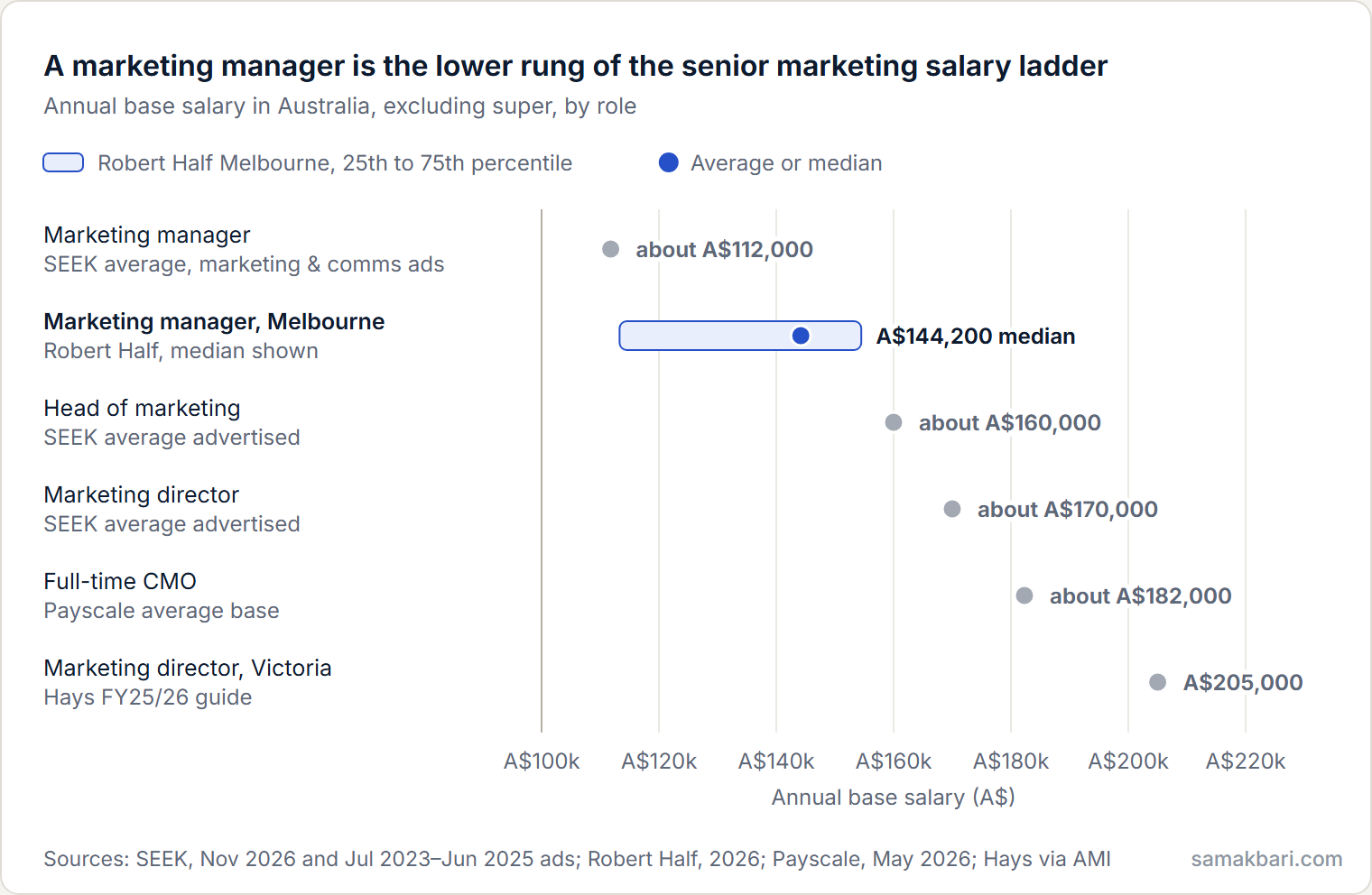
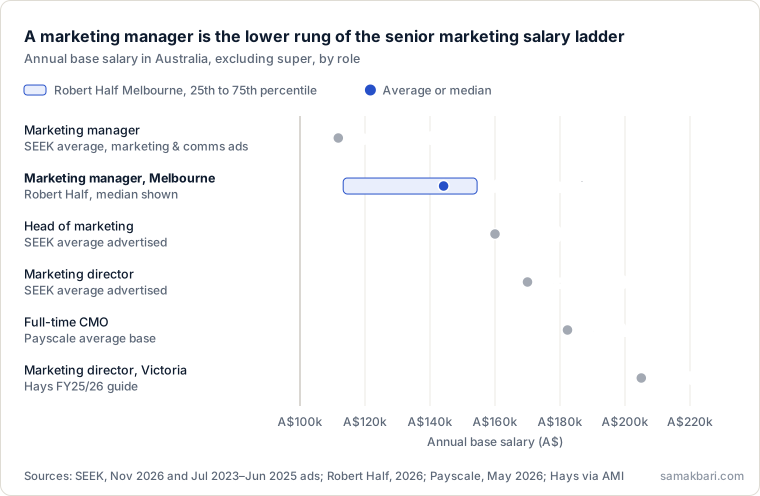
| Marketing manager, average advertised salary (marketing and communications ads) | About A$112,000 | SEEK, November 2026 |
| Marketing manager, Melbourne | A$113,300 (25th percentile), A$144,200 (median), A$154,500 (75th percentile), before super | Robert Half, 2026 |
| Head of marketing, average advertised salary | About A$160,000 | SEEK, ads from July 2023 to June 2025 |
| Marketing director, average advertised salary | About A$170,000; A$205,000 in Victoria in the Hays FY25/26 guide | SEEK; Hays via the AMI |
| Full-time CMO, average base | About A$182,000, plus a bonus of A$2,000–A$98,000 | Payscale, 57 profiles, May 2026 |
| Fractional CMO, monthly retainer | A$10,000–A$18,000 a month | Fractionus |
SEEK’s figures are averages of salaries advertised in job ads, and some ads include super. Robert Half’s exclude super and bonuses.
A worked example: Melbourne, year one
| Cost line | Marketing manager (Robert Half median) | Fractional CMO, about 1 day a week |
|---|---|---|
| Base salary or fees | A$144,200 | A$144,000 (12 × A$12,000) |
| Super guarantee at 12% | A$17,300 | Nil: invoiced through a company |
| Victorian payroll tax at 4.85% (on salary and super) | A$7,800 | Nil |
| Year-one cost | About A$169,300 | A$144,000 + GST |
| Not included | Leave loading, workers’ compensation, recruitment, laptop and software | Travel, if any, agreed in the quote |
| What you get | Five days a week of execution | One day a week of senior direction, plus the team’s or agency’s execution |
Super: the ATO sets the super guarantee at 12%. Payroll tax: the Victorian State Revenue Office rate is 4.85% on wages above the A$1 million threshold, and super counts as wages; below the threshold, leave that line out. A manager at SEEK’s average of about A$112,000 would cost about A$131,000 on the same basis. Why a fractional executive isn’t on your payroll: is a fractional executive an employee or a contractor?
So the money is closer than most CEOs expect. The real question is whether you need a senior head or a pair of hands for that money, and for many businesses the honest answer is both, in sequence.
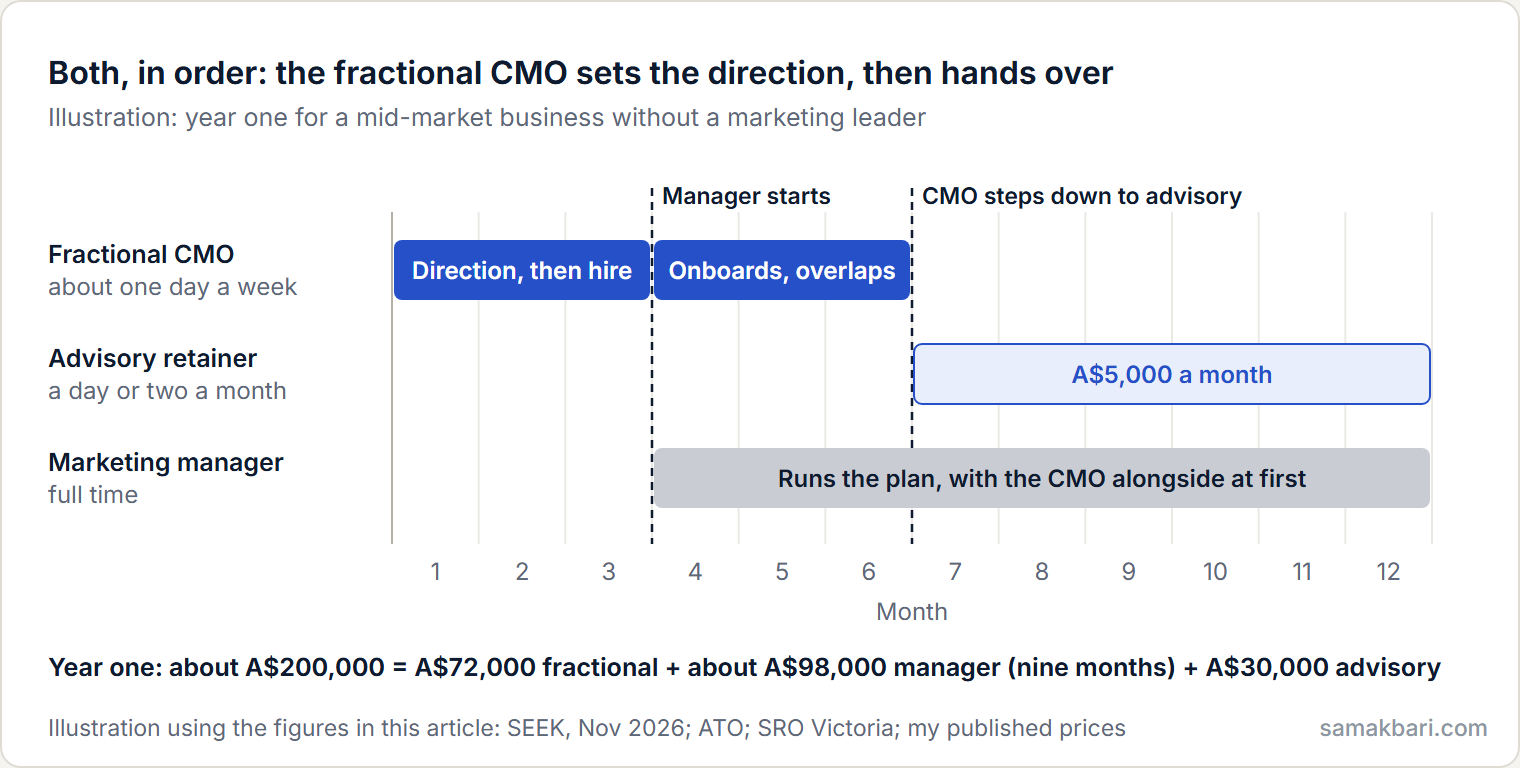
The third option: both, in order
The pattern I’d recommend for most mid-market businesses without a marketing leader:
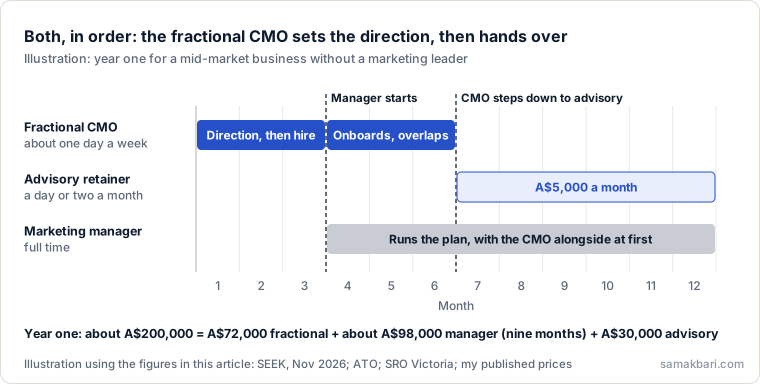
- Months 1–3: a fractional CMO sets the direction. Positioning, target customers, the plan, the budget and three or four measures that connect to pipeline. This is also when you find out whether the current agency, if you have one, is the right one.
- Months 2–3: the CMO writes the marketing manager’s role and runs the search with you. The job description describes a real plan, so you attract people who want to run one, and you interview against it.
- Months 4–6: overlap. The new manager runs the plan with the CMO alongside, weekly. They inherit a budget, a rhythm and a set of measures, not a blank page.
- Month 7 onwards: step down. The fractional CMO moves to an advisory retainer of a day or two a month, or leaves, and the manager owns delivery.
Using the figures above, that year costs roughly A$200,000: six months of the fractional seat (A$72,000), nine months of a manager at SEEK’s average (about A$98,000 with super and payroll tax) and six months of advisory at A$5,000 a month (A$30,000). That’s more than either option alone, but you get a strategy, a well-chosen hire who starts with a plan, and a senior sounding board afterwards. It’s still a little under the cost of a full-time CMO, which at Payscale’s average base comes to about A$214,000 with super and Victorian payroll tax, before any bonus or a search fee. With a manager at Robert Half’s Melbourne median instead of SEEK’s average, the year comes to about A$229,000, a little over it: the sequence buys a better start, not a saving.
When neither is the right answer
- If the problem is sales, pricing or the offer, not marketing, a marketing hire of either kind won’t fix it. You may need someone who owns revenue end to end. I take on that seat as a fractional CRO and CMO, and I’ve written about what a fractional CRO or CMO costs.
- If you have a specific, well-defined job, such as a website rebuild or a paid search program, an agency or a specialist freelancer is faster and cheaper than any hire.
- If you already have a strong marketing manager who needs a sounding board, not a boss, an advisory retainer from A$5,000 + GST a month may be all you need.
- If you can’t tell which problem you have, start with a diagnosis. My go-to-market diagnostic is about two weeks and ends with board-ready findings and a 90-day plan, from A$15,000 + GST.
How to make the marketing manager hire work
Whichever route you take, the marketing manager hire succeeds or fails on the same few things:
- Give them a plan to run, or a senior person who will write it with them in the first month.
- Agree three or four measures up front that connect to pipeline, not only to channel activity.
- Decide who they report to. If it’s the CEO, protect a weekly hour for it. If it’s a fractional CMO, make that line clear to the agency too, so it hears one voice.
- Hire for the plan, not the title. “Marketing manager”, “head of marketing” and “marketing director” mean different things in different businesses. Write down what the person will own, then set the title and salary from the table above.
If you’re briefing a fractional CMO first, how to brief a fractional executive has a one-page template for what to write down before you start.
The bottom line
A fractional CMO and a full-time marketing manager cost about the same over a year in Melbourne, but they fill different gaps. If the direction is clear and you need capacity, hire the marketing manager. If nobody senior owns the strategy, bring in a fractional CMO first, then let them hire and set up the marketing manager who will run it. You can run your own numbers in the fractional vs full-time cost calculator.
If you’re not sure which gap you have, book a 30-minute call. I’ll tell you straight, including when the answer is “hire the marketing manager and you don’t need me”. You can also read how I work as a fractional CMO and CRO.
Common questions
How much does a marketing manager cost in Australia?
Advertised marketing manager salaries in marketing and communications average about A$112,000 on SEEK (November 2026), and Robert Half's 2026 figures for Melbourne run from A$113,300 at the 25th percentile to A$154,500 at the 75th, with a median of A$144,200, before super. Add 12% super guarantee and, once your payroll passes A$1 million in Victoria, 4.85% payroll tax. A Melbourne marketing manager at the median costs about A$169,000 a year before leave loading, recruitment and tools.
Is a fractional CMO cheaper than a full-time marketing manager?
Over a year they cost about the same. My fractional CMO seat is A$144,000 + GST for twelve months at about one day a week, and a Melbourne marketing manager at the median costs about A$169,000 with super and payroll tax. The difference is what you buy. The manager gives you five days of execution. The fractional CMO gives you one day a week of senior direction and accountability for what marketing contributes to revenue.
Can a fractional CMO manage our marketing manager?
Yes, and that's often the best arrangement. The fractional CMO sets the strategy, the priorities and the measures, and the marketing manager runs the plan day to day. They usually meet weekly, and the manager gets a senior coach as well as a boss.
Should our first marketing hire be senior or junior?
Senior enough to run the work without supervision, but not so senior that you're paying for strategy nobody has asked them to set. If the strategy is already clear, hire an experienced marketing manager. If it isn't, a junior hire will struggle, and even a strong manager will end up guessing at the direction.
When should we hire a full-time CMO instead?
When marketing is big enough to need a senior leader every day. That usually means a marketing team of several people, a large budget across many channels, and a board that expects marketing to own a share of the revenue number. Payscale puts the average Australian CMO base at about A$182,000, so most mid-market businesses get there only after a fractional CMO has built the function.
How long does a fractional CMO stay once the marketing manager starts?
Usually a few months of overlap, so the new manager inherits a plan, a budget and a rhythm rather than a blank page. After that, many businesses step down to an advisory retainer of a day or two a month, which keeps a senior sounding board in place for the manager and the CEO.