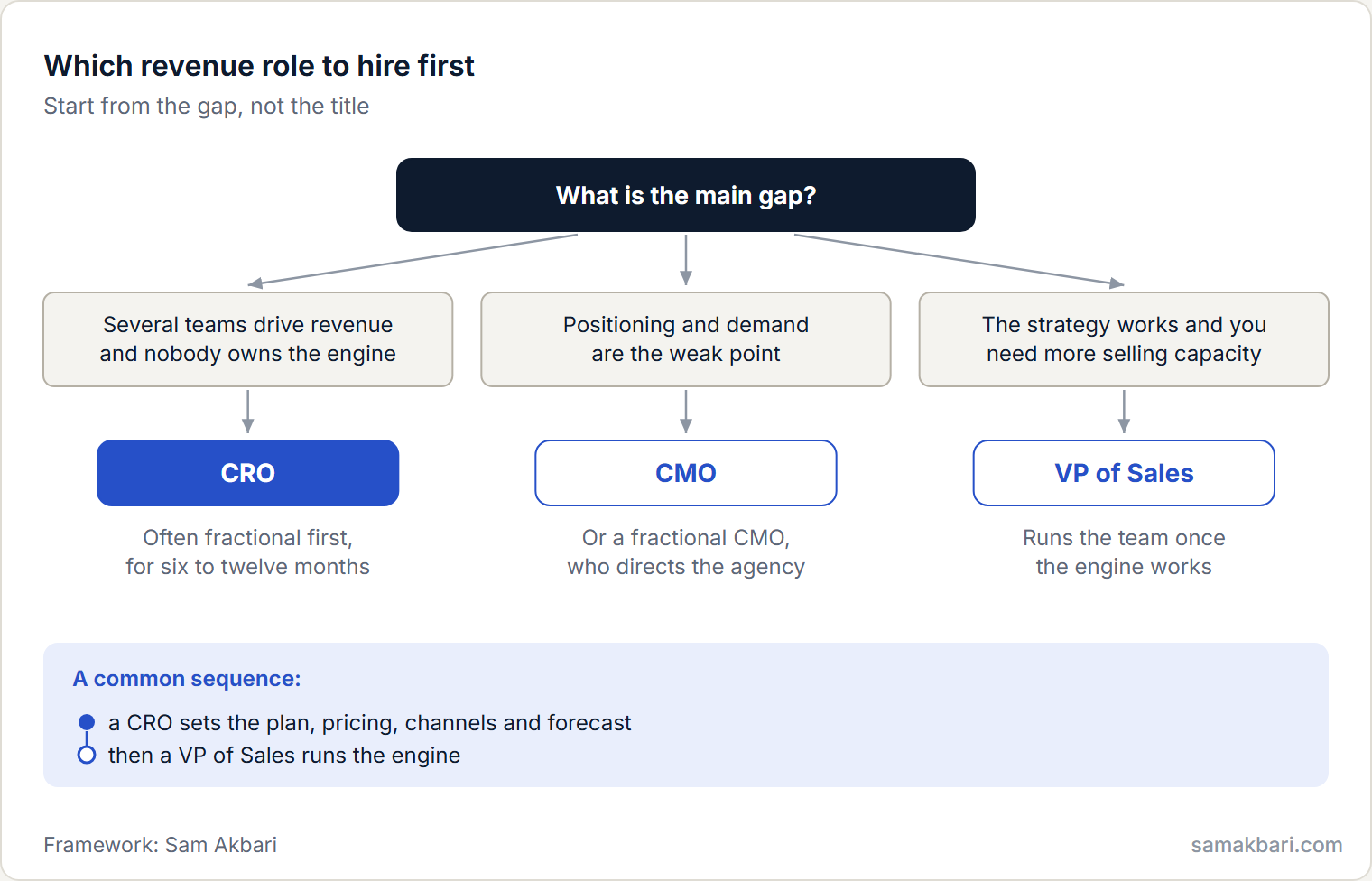

Short answer: a chief revenue officer (CRO) is the executive who owns every function that brings in revenue, usually marketing, sales, partners and customer success, with one plan and one number. A CMO owns positioning, brand and demand. A VP of Sales owns the sales team and this quarter’s target. You need a CRO when growth depends on those teams working as one engine and nobody senior owns it end to end.
I was Chief Revenue & Marketing Officer of an ASX-listed technology company, and I now work as a fractional CRO and CMO for Australian mid-market companies. Here’s what the role really involves, how it differs from the two roles it’s most often confused with, and what each one costs in Australia.
What is a chief revenue officer?
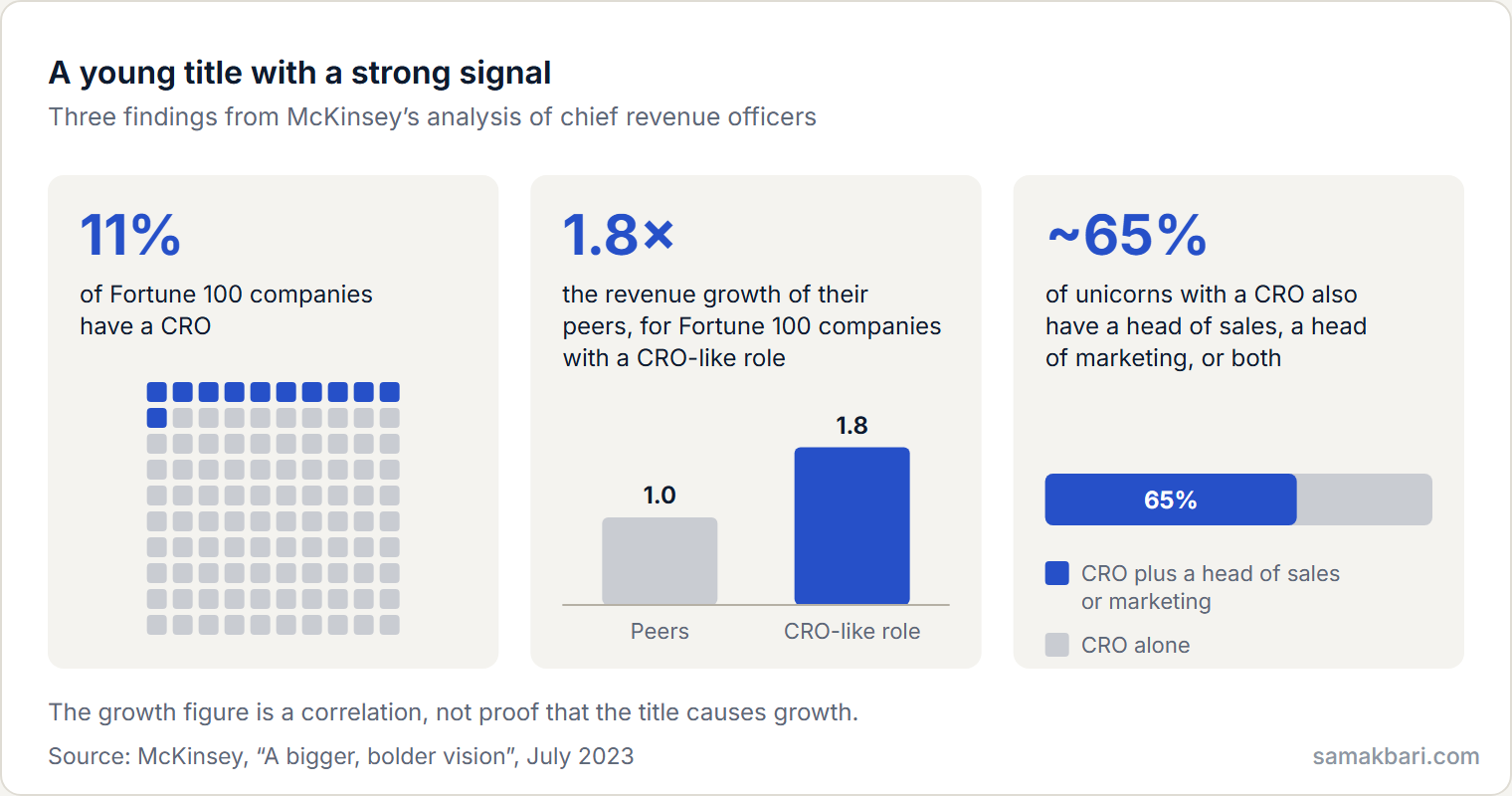
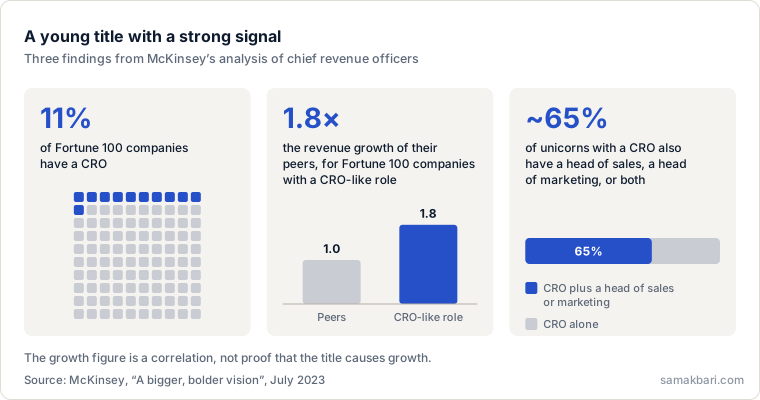
McKinsey describes the CRO’s job as creating “a single revenue engine”, from lead generation to closing the sale, and notes that the same role goes by other names: chief growth officer, chief commercial officer and others (McKinsey, July 2023). The title is still young. Only 11% of Fortune 100 companies had a CRO when McKinsey looked, although those with a CRO-like role showed 1.8 times the revenue growth of their peers. That’s a correlation, not proof that the title causes growth, but it shows where the largest companies think the gap is.
Australia doesn’t track the role separately. ANZSCO, the occupation list Jobs and Skills Australia publishes data on, has no CRO; the closest occupation is sales and marketing managers, about 118,500 people, whose tasks run from formulating sales and marketing plans to “setting prices and credit arrangements” (Jobs and Skills Australia, ANZSCO 131112). That’s a fair description of the CRO’s remit. The difference is that the CRO holds all of it in one seat, with one number.
What does a CRO actually own?
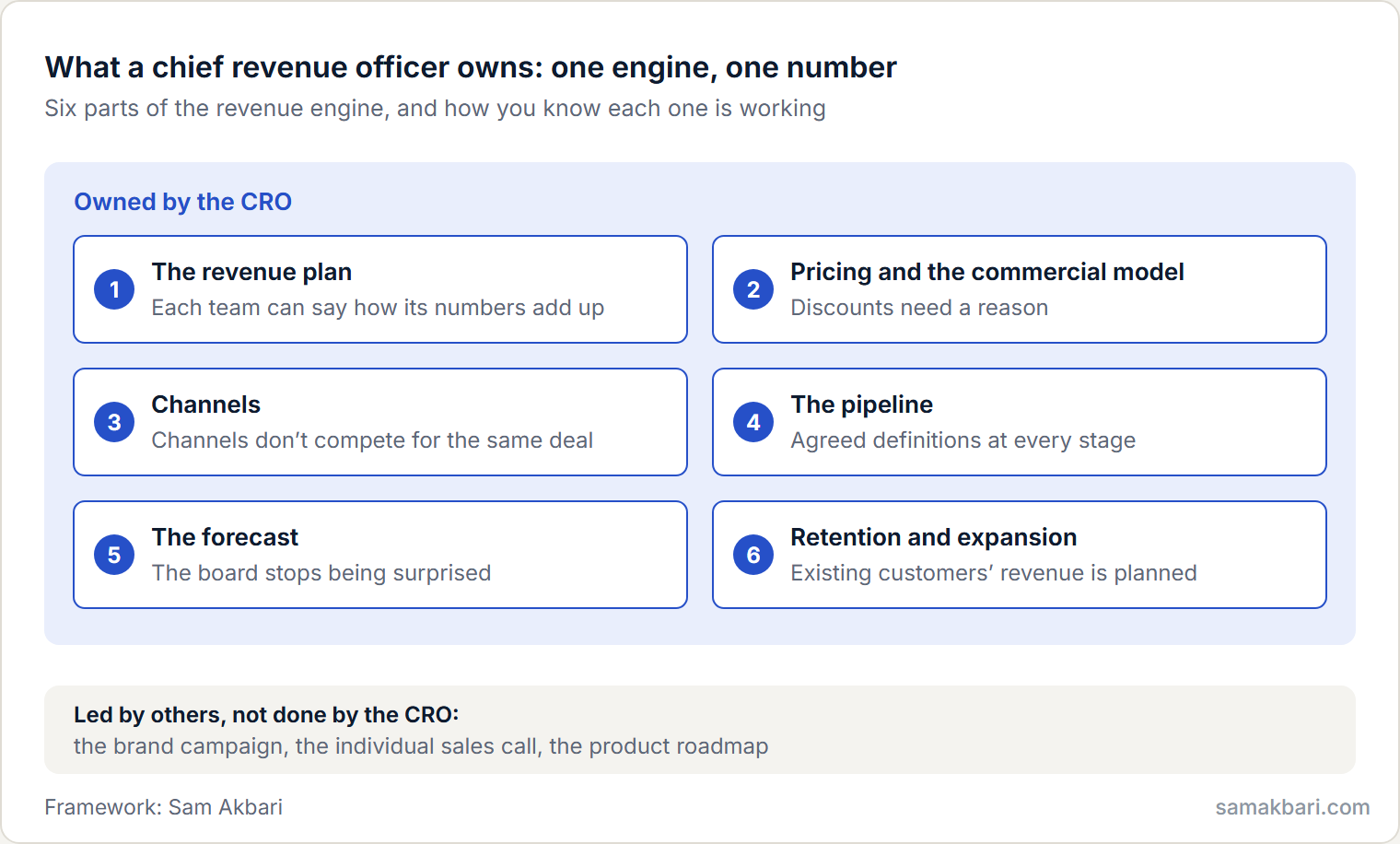
In a mid-market business, the CRO’s job usually comes down to six things.
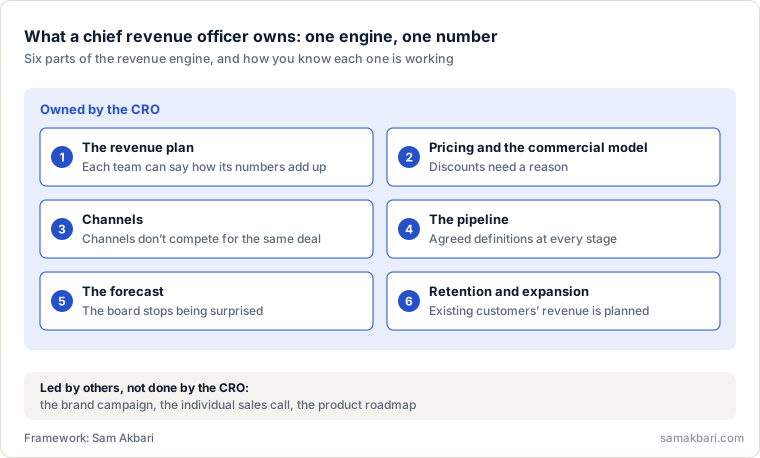
| What the CRO owns | What it means in practice | How you know it’s working |
|---|---|---|
| The revenue plan | One target, broken down by segment, channel and quarter, that marketing, sales and customer success all work to | Each team can say how its numbers add up to the company’s |
| Pricing and the commercial model | List prices, discounting rules, packaging and the revenue model | Discounts need a reason, and price realisation is measured |
| Channels | Direct, partner, carrier and online routes to market, and how they share customers | Channels don’t compete for the same deal |
| The pipeline | From first touch to closed revenue, with agreed definitions at each stage | Marketing and sales argue about tactics, not about whose leads count |
| The forecast | The number the CEO and board plan on | The board stops being surprised late in the quarter |
| Retention and expansion | Renewals, upsell and the handover from sales to delivery | Revenue from existing customers is planned, not hoped for |
Notice what’s missing: the brand campaign, the individual sales call and the product roadmap. A CRO leads the people who own those, but doesn’t do their jobs.
CRO vs CMO vs VP of Sales: who does what?
| CRO | CMO | VP of Sales or sales director | |
|---|---|---|---|
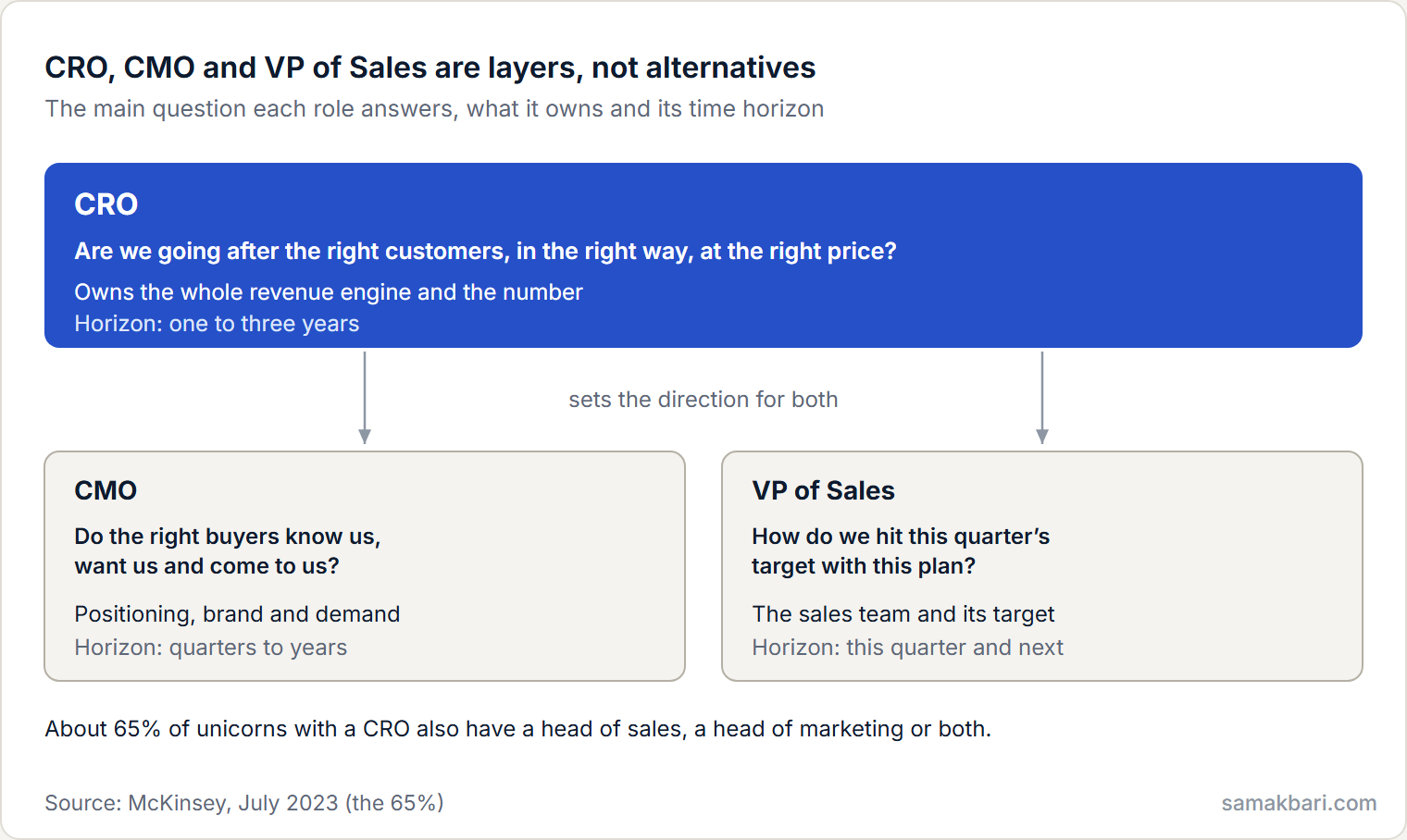
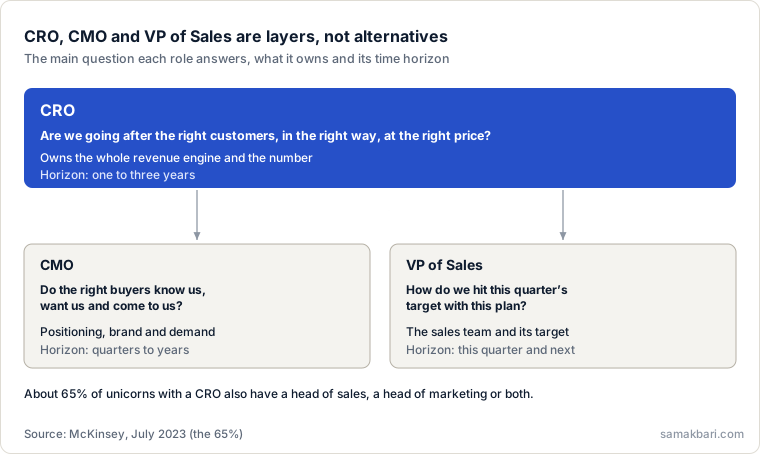
| Main question | Are we going after the right customers, in the right way, at the right price? | Do the right buyers know us, want us and come to us? | How do we hit this quarter’s target with this plan? |
| Owns | The whole revenue engine and the number | Positioning, brand, demand and marketing spend | The sales team, its targets and the sales process |
| Measured on | Revenue against plan, pipeline coverage, forecast accuracy, price realisation | Pipeline sourced by marketing, brand reach, cost per opportunity | Bookings, win rate, sales cycle, quota attainment |
| Time horizon | One to three years | Quarters to years | This quarter and next |
| Usually reports to | The CEO, with a direct line to the board | The CEO, or the CRO | The CRO, or the CEO if there’s no CRO |
| Hire when | Several teams drive revenue and nobody owns the whole engine | Positioning and demand are the main gap | The strategy works and you need more selling capacity |
The three roles aren’t alternatives so much as layers. McKinsey found that about 65% of unicorns with a CRO also have a head of sales, a head of marketing or both, and warns that the CRO “should not be confused with the vice president of sales”. The CRO sets the direction across both functions. The heads of sales and marketing run them.
The confusion is mostly a mid-market problem. A business of 50 to 500 people can rarely afford all three full-time, so it hires one and expects them to do the others’ jobs. A common version is a strong VP of Sales asked to fix pricing, positioning and channels. I’ve written about that mistake, and the sequence that avoids it, in when to hire a fractional CRO vs a VP of Sales.
What does a CRO’s week look like?
Less selling than people expect. Most of it is making sure the parts of the engine connect.
At the ASX-listed technology company, I was first engaged as a consultant to build the global go-to-market strategy. The company then created the role of Chief Revenue & Marketing Officer, and I took on all sales and marketing. The work that mattered most wasn’t in any single team. It was setting one commercial model across direct, partner and carrier channels, including pricing, the revenue model and the business model, and owning a global P&L of around A$15M outside China. That’s the CRO’s job: the plan I’d written was the one I had to deliver. The full story is in building a global go-to-market.
The same lens applies outside technology. When I developed the go-to-market for an ASX-listed investment group’s IPO campaigns, one raised more than A$300M. The job there was the same discipline: keep the internal stakeholders and the external marketing and technology suppliers delivering to the campaign’s fixed timeline.
What do a CRO, a CMO and a VP of Sales earn in Australia?
| Role | Average base salary | Base range (10th to 90th percentile) | Bonus or commission on top | Profiles |
|---|---|---|---|---|
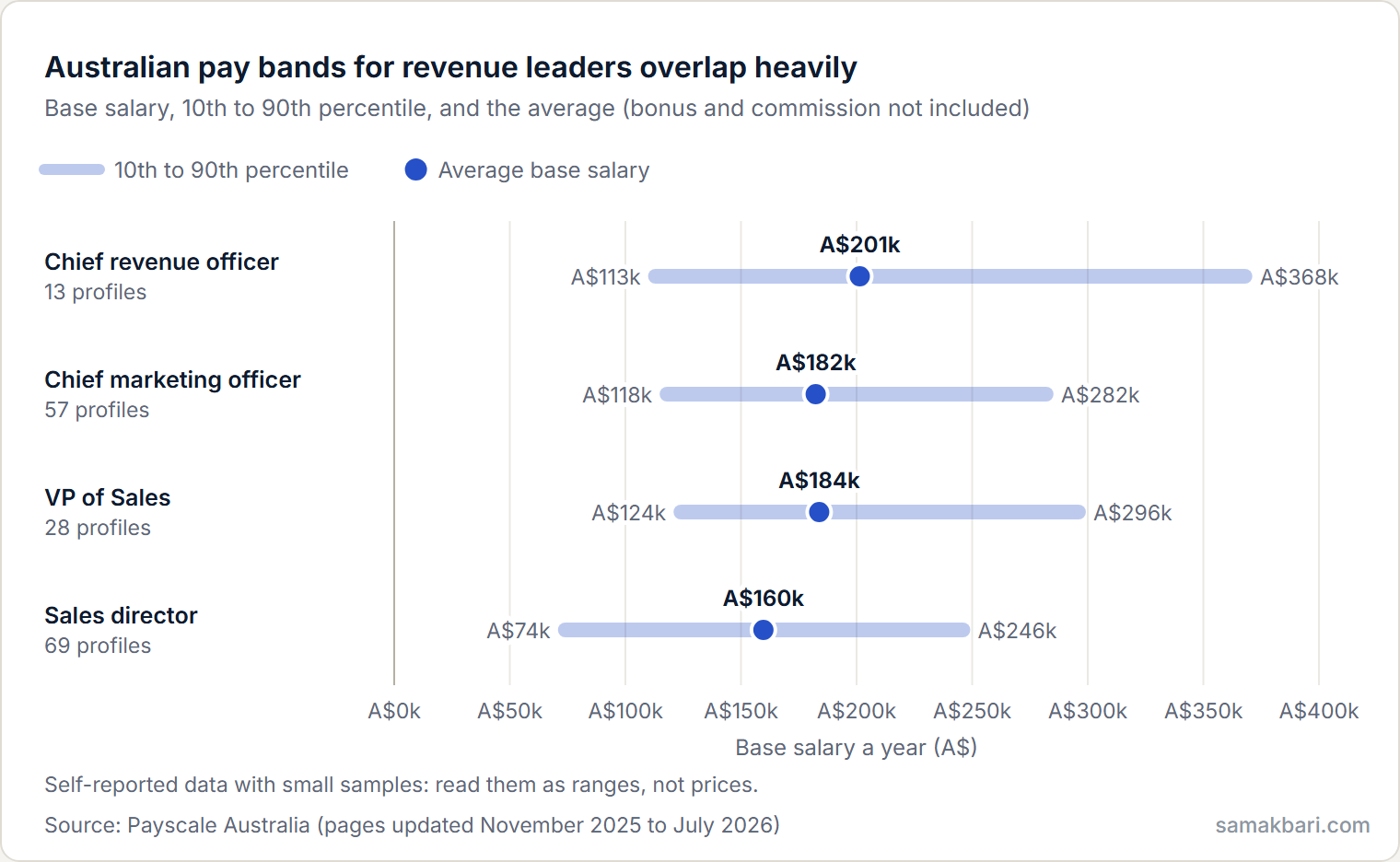
| Chief revenue officer | A$201,391 | A$113,000–A$368,000 | Bonus A$26,000–A$90,000 | 13 |
| Chief marketing officer | A$182,321 | A$118,000–A$282,000 | Bonus A$2,000–A$98,000 | 57 |
| VP of Sales | A$183,831 | A$124,000–A$296,000 | Bonus A$10,000–A$145,000; commission A$50,000–A$150,000 | 28 |
| Sales director | A$159,702 | A$74,000–A$246,000 | Bonus A$4,000–A$59,000; commission A$16,000–A$175,000 | 69 |
Sources: Payscale Australia for the CRO (updated February 2026), CMO (May 2026), VP of Sales (November 2025) and sales director (July 2026). Self-reported data with small samples, so read them as ranges, not prices.
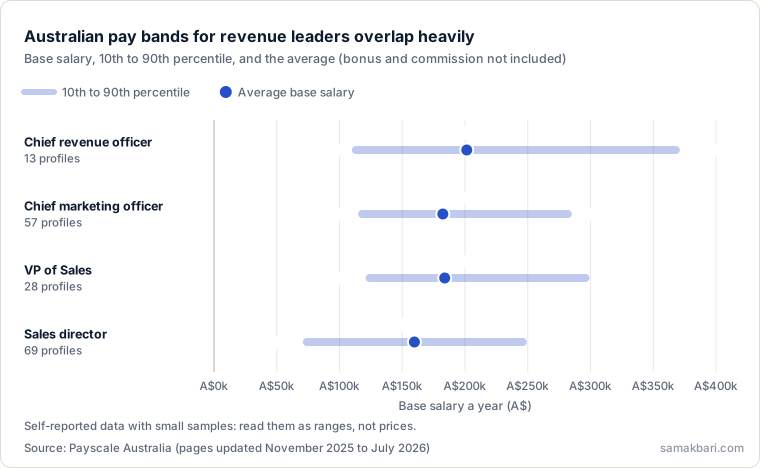
Two things stand out. First, the base salaries overlap heavily: a senior VP of Sales can earn more than a CRO at a smaller company. The difference is in what they’re accountable for, not the pay band. Second, variable pay is structured differently. Payscale lists commission on top of base for VPs of Sales (A$50,000–A$150,000) and sales directors (A$16,000–A$175,000), but only a bonus for CROs and CMOs. Super, payroll tax and leave come on top of all of these, and my fractional CRO cost guide works through the full year-one cost of a CRO hire.
Does a mid-market company need a full-time CRO?
Often not, at least not yet. Many businesses of 50 to 500 people need a CRO’s work for six to twelve months, to set the revenue plan, pricing, channels and forecast, and then a strong VP of Sales or sales director to run the engine once it works. Those are different jobs, and they can be hired in that order.
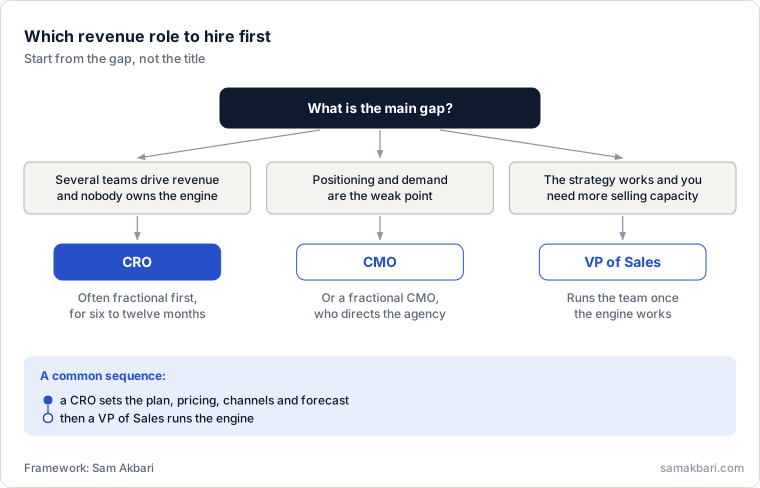
That’s what a fractional CRO is for: the same seat, for part of the week. Australian fractional CRO retainers typically run A$10,000–A$18,000 a month (Fractionus). My fractional CRO and CMO seats start from A$12,000 + GST a month for about one day a week, and a two-week go-to-market diagnostic from A$15,000 + GST. You can compare the numbers with a full-time hire in the fractional vs full-time cost calculator.
A full-time CRO is the better choice when revenue runs through a large sales organisation that needs daily leadership, or when you’re preparing for a raise or an exit and investors expect a permanent revenue leader in the team. If the real gap is marketing rather than the whole engine, read fractional CMO or marketing agency first. And if you’re defining the rest of the leadership team, I’ve also written about what a COO actually does.
The bottom line
A chief revenue officer owns the whole revenue engine: the plan, pricing, channels, pipeline, forecast and retention, with one number. A CMO owns how buyers find and choose you. A VP of Sales owns the team that closes the deals. Most mid-market companies need all three kinds of work, but not three full-time executives, and the order you hire them in matters more than the titles.
If you’re not sure which gap you have, read how I work as a fractional CRO and CMO, or book a 30-minute call and we’ll work out which role your business needs first.
Common questions
What does CRO stand for in business?
In a leadership team, CRO usually means chief revenue officer, the executive who owns every function that brings in revenue. In banks and insurers it can also mean chief risk officer, and in marketing it sometimes means conversion rate optimisation, so check the context of the job ad.
Is a CRO higher than a CMO?
Often, but not always. Where a business has both, the CMO may report to the CRO, because the CRO owns the whole path from first touch to closed revenue. In other businesses the CRO and CMO are peers who both report to the CEO. What matters is that one person is accountable for the revenue number.
Does the VP of Sales report to the CRO?
Yes, in most structures that have both. The CRO sets the revenue strategy and the targets, and the VP of Sales or sales director runs the team that delivers them. McKinsey found that about 65% of unicorns with a CRO also have a head of sales, a head of marketing or both.
How much does a chief revenue officer earn in Australia?
Payscale puts the average base salary for a CRO in Australia at about A$201,000, with a range of roughly A$113,000 to A$368,000 and bonuses of A$26,000 to A$90,000. That figure comes from only 13 profiles, so treat it as a guide. Australian fractional CRO retainers typically run A$10,000 to A$18,000 a month.
What is the difference between a CRO and a chief commercial officer?
Mostly the name. McKinsey notes that the same job is called chief growth officer, chief commercial officer or CRO depending on the company. Check the scope in the job description rather than the title.
When does a company need a chief revenue officer?
When revenue depends on several teams that don't share one plan, such as marketing, sales, partners and customer success, and nobody senior owns the number end to end. In a mid-market business that usually shows up as stalled growth, a forecast nobody trusts or a step change such as a new market, a raise or an exit.